
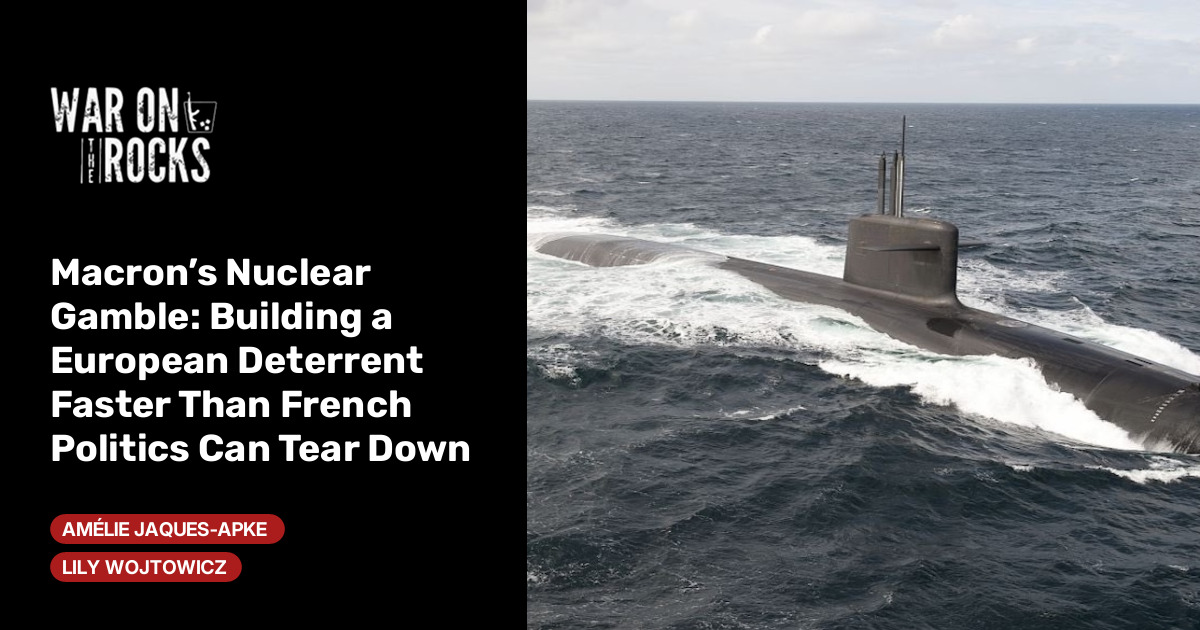
Macron’s Nuclear Policy Shift: Advanced Deterrence and European Security
What’s Behind France’s Nuclear Policy Shift?
In early March, French President Emmanuel Macron announced a seismic shift in France’s nuclear strategy, moving away from decades of secrecy and sovereign restraint. The changes include expanding the nuclear arsenal, ending transparency over its size, and offering European allies a role in French nuclear planning. According to a report by the Center for Political Research at Sciences Po Paris, this marks a departure from the “strict sufficiency” doctrine that defined French nuclear policy since the 1980s. Macron’s move, described as “advanced deterrence,” aims to reassure European partners amid growing doubts about U.S. extended nuclear guarantees.
How Does Advanced Deterrence Differ from NATO?

Macron’s framework is designed to complement, not replace, NATO’s nuclear mission. However, key differences exist. Unlike NATO’s nuclear sharing arrangements, which involve host-nation pilots delivering U.S. nuclear bombs, France’s plan keeps control of delivery in French hands. For example, Rafale jets carrying ASMPA-R missiles would operate from allied airfields during exercises, but French crews would handle the missions. This distinction raises questions about whether allies will fully trust the system. According to Lily Wojtowicz, a Ph.D. candidate at American University, “The operational role of allies is limited, which could weaken reassurance.”
Why Is the 2027 French Election a Critical Deadline?
Macron’s nuclear ambitions face a significant political hurdle: the 2027 presidential election. The far-right Rassemblement National (RN) has repeatedly criticized European nuclear commitments, framing them as a threat to French sovereignty. Marine Le Pen has called advanced deterrence a “dispersion of our nuclear means,” warning it could “weaken democracy.” Historical precedents, such as Charles de Gaulle’s rejection of the 1958 Franco-Italian-German nuclear project, highlight the fragility of such initiatives. As Amélie Jaques-Apke, a researcher at the Friedrich Naumann Foundation, notes, “Macron is trying to create institutional facts that a successor might find costly to dismantle.”
The Franco-German Nuclear Partnership: A New Era?
The Franco-German nuclear steering group represents a historic shift. For the first time, Germany is engaging in nuclear coordination outside NATO. This collaboration includes joint exercises, such as Germany’s participation in France’s classified Poker drills, and visits to strategic nuclear sites. However, Germany’s simultaneous recommitment to the U.S. nuclear umbrella complicates the dynamic. The 2022 decision to procure F-35A fighters—capable of delivering U.S. B61 bombs—underscores Berlin’s reliance on Washington. “Germany is hedging, but not abandoning the American guarantee,” says Wojtowicz.
What Risks Does France’s Smaller Arsenal Pose?
France’s nuclear arsenal, fewer than 300 warheads, is smaller than NATO’s. This raises concerns about its ability to provide the “flexible, graduated responses” that extended deterrence theory demands. Unlike the U.S. counterforce capability, France’s “strict sufficiency” doctrine focuses on counter-value strikes—targeting cities rather than military assets. “A doctrine of ‘all or nothing’ is hard to accept for allies accustomed to U.S. escalation-ladder thinking,” Jaques-Apke explains.
The Road Ahead: Stability or Collapse?
Macron’s framework hinges on institutionalizing consultations and joint exercises before 2027. The Franco-German steering group and formalized NATO partnerships are critical. However, the risk of domestic political reversal remains. If the RN wins in 2027, it could dismantle the initiative, echoing de Gaulle’s rejection of the Mollet government’s 1958 nuclear project. “The coming work between France and its allies will be critical,” Jaques-Apke says. “Without continuity, advanced deterrence risks becoming another abandoned European defense initiative.”
FAQ
What is France’s Advanced Deterrence Framework?
Advanced deterrence is a new strategy offering European allies strategic dialogues, nuclear exercise invitations, and potential forward basing of French dual-capable aircraft. It aims to complement NATO’s nuclear mission while addressing doubts about U.S. commitment.
Why is the 2027 French Election Significant?
The 2027 election could determine the fate of Macron’s nuclear policy. The far-right RN opposes European nuclear commitments, raising concerns that the framework might be reversed if it loses support.
How Does France’s Arsenal Compare to NATO’s?
France’s arsenal is smaller than NATO’s, with fewer than 300 warheads. Unlike NATO’s counterforce capability, France’s doctrine focuses on counter-value strikes, targeting cities rather than military assets.
Did You Know?
France’s nuclear policy has evolved significantly since the 1980s. The current shift marks the first time the country has considered deploying nuclear weapons to protect allies beyond its borders.