
Massive 415-Million-Year-Old Fossil Identified as Possibly the Largest Scorpion Ever
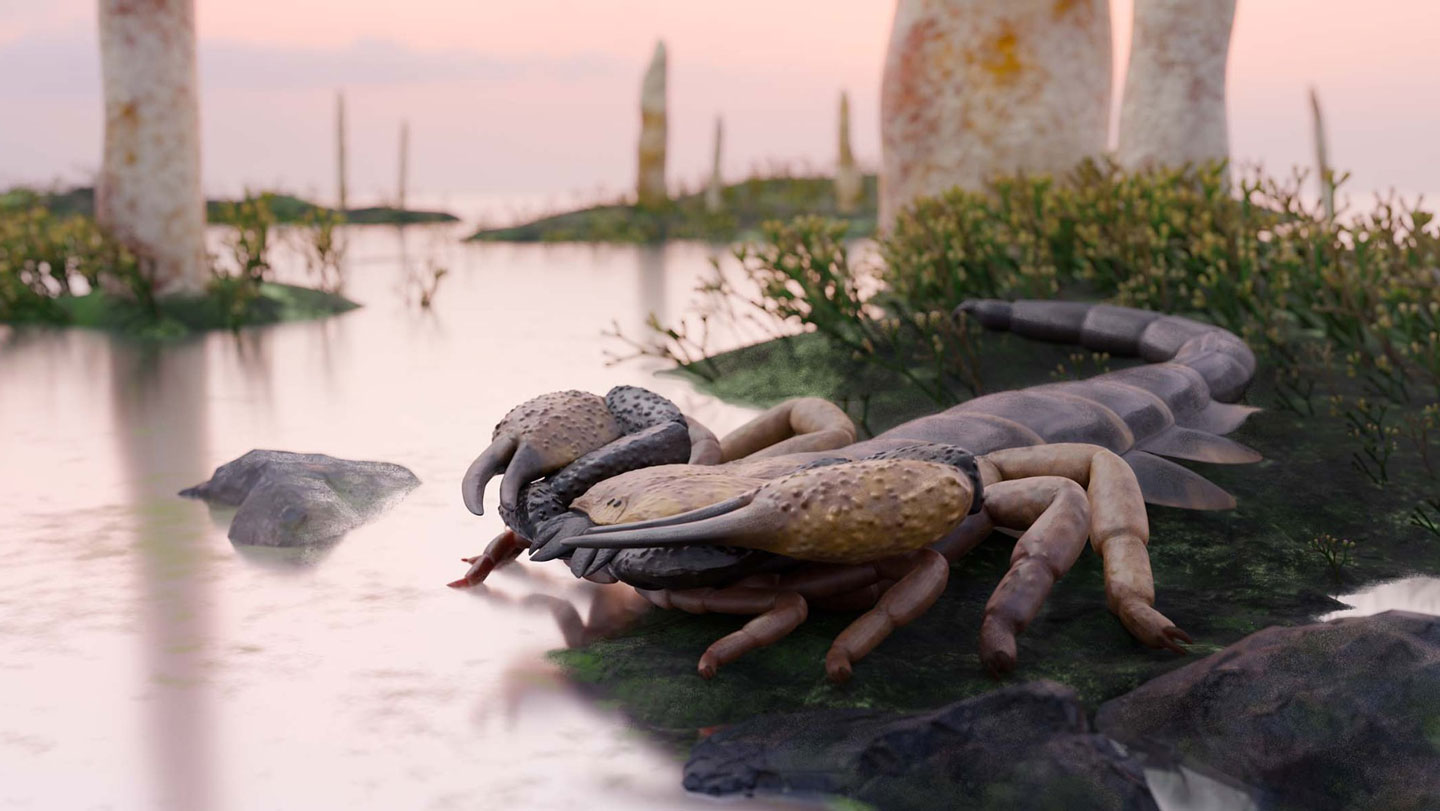
Researchers have identified Praearcturus gigas, a fossil discovered in England in 1870, as potentially the largest scorpion to ever exist. Measuring approximately one meter in length, the 415-million-year-old creature was four to five times the size of the largest modern scorpion, Gigantometrus swammerdami, according to a report published June 2 in Palaeontology.
Did You Know? Fragments of Praearcturus gigas were first unearthed in 1870 in the St Maughans geologic formation, though scientists spent over 150 years misidentifying the creature as a giant woodlouse or a millipede-like animal before confirming its identity as a scorpion.
How Researchers Confirmed the Scorpion’s Identity
Paleobiologist Richard Howard of the Natural History Museum in London and his colleagues used modern imaging to re-examine the fossils. The team compared their photographs and illustrations to the 430-million-year-old species Eramoscorpius brucensis, discovered in 2015. This comparison revealed that both species shared an unusually elongated, nearly triangular sternum with a central groove, a feature that distinguishes them from modern scorpions with their typical pentagonal sterna.
The physical evidence also included a 15-centimeter pincer. Unlike crustaceans such as lobsters, where the movable claw points toward the fixed claw, the pincer of P. gigas featured a movable claw facing away, consistent with modern scorpion anatomy. Furthermore, the fossils showed ridges on the pedipalps, which are appendages used by various scorpion species to produce hissing sounds to deter predators.
Expert Insight: The discovery of Praearcturus gigas highlights a significant evolutionary timeline, suggesting that scorpions reached massive proportions at least 55 million years before the giant insects of the Carboniferous period. This early shift in body size indicates that these predators may have occupied a unique, unoccupied niche in the ancient ecosystem before the rise of land vertebrates.
Implications for Ancient Ecosystems
P. gigas likely functioned as an early terrestrial predator. Because the species lived during a period when land vertebrates were not present to compete for resources, it occupied a top-tier role in its environment. However, researchers suggest that terrestrial resources were likely insufficient to sustain such a large creature.
The geological context provides further clues regarding the animal’s habitat. According to Howard, the fossils were deposited by rivers, indicating the scorpion may have lived in freshwater environments. In these settings, P. gigas likely preyed on large species such as sea scorpions and armored fish. The fossil also displays flaplike structures that resemble the swimming appendages found on modern lobsters, though scientists require additional evidence to confirm their specific function.
What May Happen Next
Future research will likely focus on gathering more fossil evidence to clarify the function of the creature’s flaplike appendages. By analyzing these structures, paleontologists aim to determine the extent to which this species was adapted for aquatic versus terrestrial life. Additionally, further comparisons between P. gigas and other ancient arthropods may reveal more about how early scorpions evolved their distinct morphology.
Frequently Asked Questions
How big was Praearcturus gigas?
The creature reached approximately one meter in length, making it four to five times larger than the largest modern scorpion species.
Why was the identification of this fossil delayed?
The fossil was discovered in 1870, but researchers lacked a key point of comparison until the 2015 discovery of Eramoscorpius brucensis, which allowed scientists to confirm the identity of P. gigas.
What did this ancient scorpion eat?
It likely preyed on small land animals and, due to the scarcity of terrestrial resources, may have hunted larger species like armored fish and sea scorpions in river environments.
How do you think the discovery of such large ancient predators changes our understanding of early terrestrial life?