
Military Deployment at Student Protest Sparks Debate in Indonesia
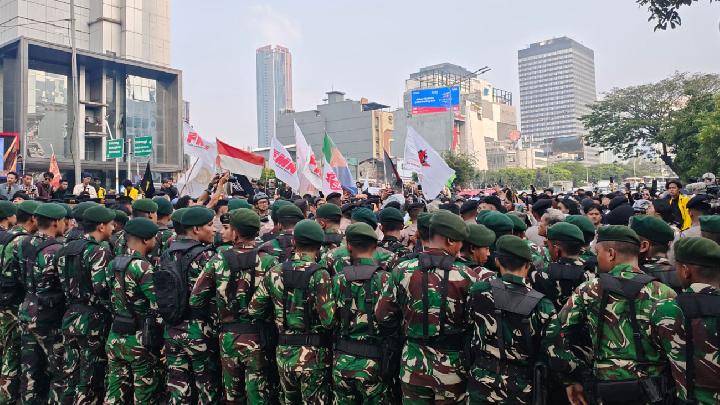
Hundreds of Indonesian National Armed Forces (TNI) personnel joined police to block student protesters from reaching the Bundaran HI area in Jakarta on June 12, 2026. Brigadier General Muhammad Nas stated the military acted on a police request to secure the “Towards Bankrupt Indonesia” demonstration.
TNI soldiers and police officers established barricades to close off access to the planned protest site. The joint operation aimed to prevent the student alliance from entering the HI Roundabout area.
Brigadier General Muhammad Nas, Head of the TNI Information Center, said on Saturday, June 13, 2026, that the military’s involvement followed applicable mechanisms. He described the deployment as “support to the National Police.”
Why was the Bundaran HI area blocked?
Minister of Human Rights Natalius Pigai stated the blockade complied with regulations to prevent demonstrations in business and traffic epicenters. He cited Jakarta Governor Regulation Number 232 of 2015 as the legal basis for the action.
Pigai also referenced the Siracusa Principles, which allow authorities to impose restrictions on public expression for strategic reasons. He maintained that no violations were committed by security forces during the blockade.
While Pigai expressed support for the students’ right to voice opinions, he argued that restrictions are permissible at locations like Bundaran HI due to traffic congestion.
How do legislative officials view the military’s role?
Dave Laksono, Vice Chair of Commission I of the House of Representatives, acknowledged that police typically handle demonstration security. However, he stated that TNI involvement is necessary to ensure public order is maintained.

Laksono, a politician from the Golkar Party, argued that defense institutions play a role alongside police to maintain national stability. He called the synergy between law enforcement and defense the “key to maintaining national stability.”
He cautioned that coordination must remain lawful and respect civil rights to maintain public trust in state institutions.
What are the concerns regarding military deployment?
The Civil Society Coalition for Security Sector Reform criticized the June 12 deployment as erroneous and contrary to democratic principles. The coalition includes Amnesty International Indonesia, KontraS, the Indonesian Legal Aid Foundation, Imparsial, Dejure, and the Indonesia Risk Center.
In a joint statement, the coalition argued that handling demonstrations falls under the jurisdiction of civil security forces. They asserted that military mobilization should only occur as a last resort when civilian apparatuses cannot control a situation.
The coalition warned that using the TNI in this capacity could lead to legal problems.
What happens next?
The disagreement between the government and civil society coalitions may lead to further legal challenges regarding the use of military personnel in civil protests. If similar protests occur, the government is likely to continue citing the Siracusa Principles and local regulations to justify restrictions in business districts.
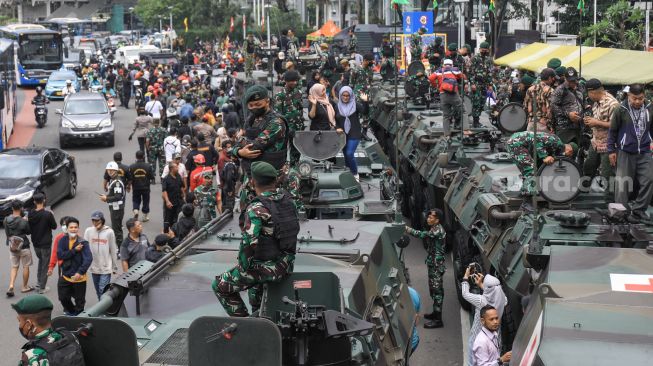
Future deployments could see increased scrutiny from the coalition of human rights organizations, who may push for stricter limits on the TNI’s role in domestic security.
Frequently Asked Questions
When did the “Towards Bankrupt Indonesia” protest take place?
The protest occurred on June 12, 2026.
Who requested the TNI’s assistance in securing the demonstration?
According to Brigadier General Muhammad Nas, the military’s involvement was based on a request from the police.
Which organizations oppose the use of the military for these protests?
The Civil Society Coalition for Security Sector Reform, which includes Imparsial, Amnesty International Indonesia, the Indonesian Legal Aid Foundation, KontraS, Dejure, and the Indonesia Risk Center.
Do you believe military support is necessary for maintaining order during large-scale urban protests?