
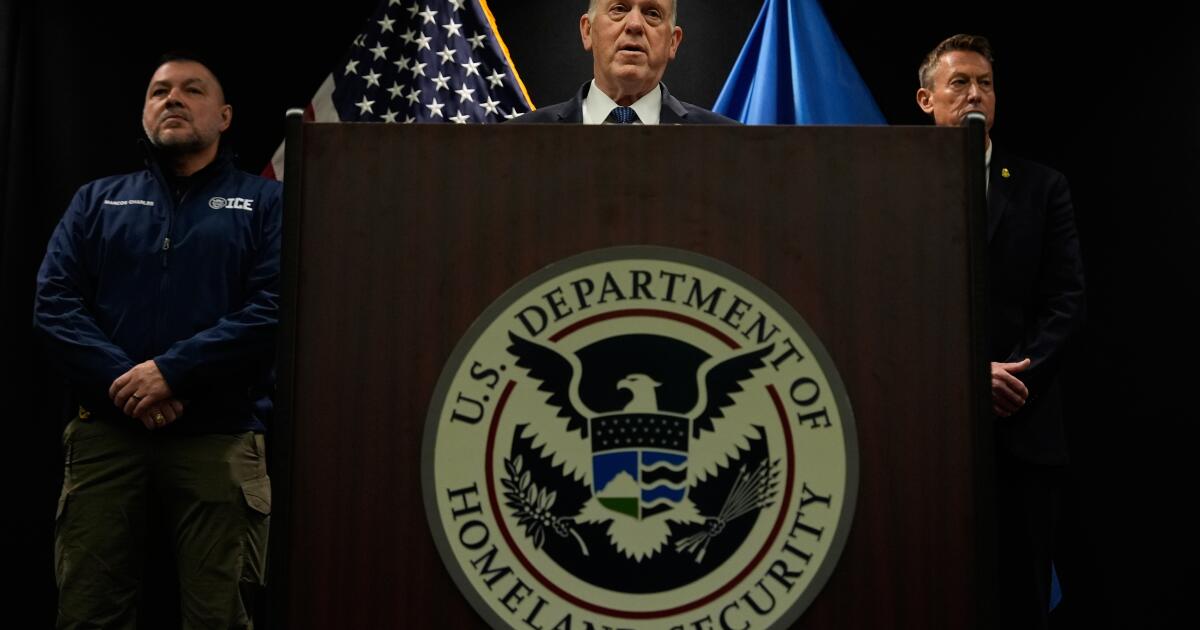
Minnesota Immigration: Homan Links Jail Access to Reduced Street Operations
Following the deaths of two U.S. citizens in Minneapolis, federal immigration operations in Minnesota are undergoing a shift in strategy. Tom Homan, a border policy advisor, announced that street operations could be scaled back if local jails cooperate with federal immigration authorities.
A Change in Tactics
Homan stated on Thursday that the withdrawal of federal law enforcement resources is contingent upon access to local jails. He emphasized that this is not a surrender of the administration’s immigration enforcement goals. “We are not surrendering our mission at all… We are not surrendering the president’s mission of immigration enforcement,” he said.
This focus on jail access isn’t new. Homan and other Trump administration officials have previously argued that cooperation from cities would allow federal agents to avoid broader community targeting. He stated last January, “Sanctuary cities lock us out of the jails.”
Collaboration and Arrest Numbers
Data indicates a correlation between cooperation and arrest numbers. Republican-led states, like Texas and Florida, have historically recorded higher numbers of immigration arrests compared to Democratic-led states, when adjusted for population. This is attributed to a longer history of collaboration with ICE, often through 287(g) agreements, where local law enforcement takes on ICE duties.
While states like California cooperate by sharing information on undocumented immigrants with serious felonies, they generally do not grant ICE access to those with lesser infractions. Red states, however, are more likely to share information on a wider range of offenses, including traffic violations.
Recent Events and Internal Directives
Homan’s arrival in Minnesota followed President Trump’s decision to sideline Border Patrol Commander Gregory Bovino amid public outcry over the shootings of Alex Pretti, a 37-year-old intensive care unit nurse, and Renee Good, a 37-year-old mother of three. Both women were U.S. citizens and were fatally shot by federal agents in Minneapolis.
Homan acknowledged the recent incidents, stating, “I’m not here because the federal government has carried out this mission perfectly.” He has since met with Minnesota Governor Tim Walz, Minneapolis Mayor Jacob Frey, and Minnesota Attorney General Keith Ellison to seek solutions.
According to Homan, Attorney General Ellison agreed that county jails “may notify ICE of the release dates of criminal public safety risks.” Homan reiterated that increased access to jails could lead to fewer agents operating in communities: “More agents in the jail means less agents in the street.”
An internal memo from ICE, reviewed by Reuters, directed officers to avoid engaging with “agitators” and to focus solely on “aliens with a criminal history.” The directive, issued by Marcos Charles, a top official in ICE’s Enforcement and Removal Operations division, instructs officers: “DO NOT COMMUNICATE OR ENGAGE WITH AGITATORS.”
Looking Ahead
If local officials grant ICE access to jails, a reduction in visible federal immigration enforcement in Minnesota communities is a possible next step. However, the success of this strategy is likely to depend on the extent of cooperation received. It is also possible that continued resistance from local authorities could lead to a prolonged federal presence. Analysts expect that the administration will continue to prioritize immigration enforcement, regardless of the specific tactics employed.
Frequently Asked Questions
What prompted the change in strategy in Minnesota?
The deaths of two U.S. citizens, Alex Pretti and Renee Good, at the hands of federal agents, and the resulting public outcry prompted President Trump to send Tom Homan to Minnesota to “fix” the situation.
What is a 287(g) agreement?
A 287(g) agreement allows local law enforcement officers to take on ICE duties, such as identifying and arresting individuals suspected of immigration violations.
What is ICE directing its officers to do regarding protesters?
ICE officers have been directed, via an internal memo, to avoid engaging with “agitators” and to focus solely on individuals with a criminal history.
Given these developments, how might the balance between federal immigration enforcement and community safety evolve in Minnesota?