

Most Americans Favor No-Excuse Early and Absentee Voting
About 59% of U.S. adults believe voters should have the option to vote early or absentee without documenting a reason, according to a Pew Research Center survey conducted April 20-26, 2026. The findings reveal a sharp partisan divide, with 81% of Democrats supporting no-excuse voting compared to only 34% of Republicans.
The survey of 5,103 adults indicates that early and absentee voting have become standard practices. In the 2024 presidential election, only about one-third of voters cast their ballots in person on Election Day.
Why do views on no-excuse voting differ by political party?
Republican support for no-excuse early or absentee voting has declined significantly over the last eight years. According to Pew Research Center, 57% of Republicans supported the option in 2018, but that number dropped to 34% by April 2026.
Democratic views remained stable during the same period. About eight-in-ten Democrats have consistently supported no-excuse voting since 2018, with 81% favoring it in the 2026 survey.
Ideology also plays a role within the parties. Moderate and liberal Republicans are 17 percentage points more likely to support no-excuse voting than conservative Republicans (44% vs. 27%), while liberal Democrats are 15 points more likely than conservative or moderate Democrats to back the practice (90% vs. 75%).
How do state laws influence voter preferences?
Voters living in states with more flexible mail-in laws are more likely to favor no-excuse voting. According to Pew Research Center, 67% of adults in states with universal mail-in ballot access support the option.
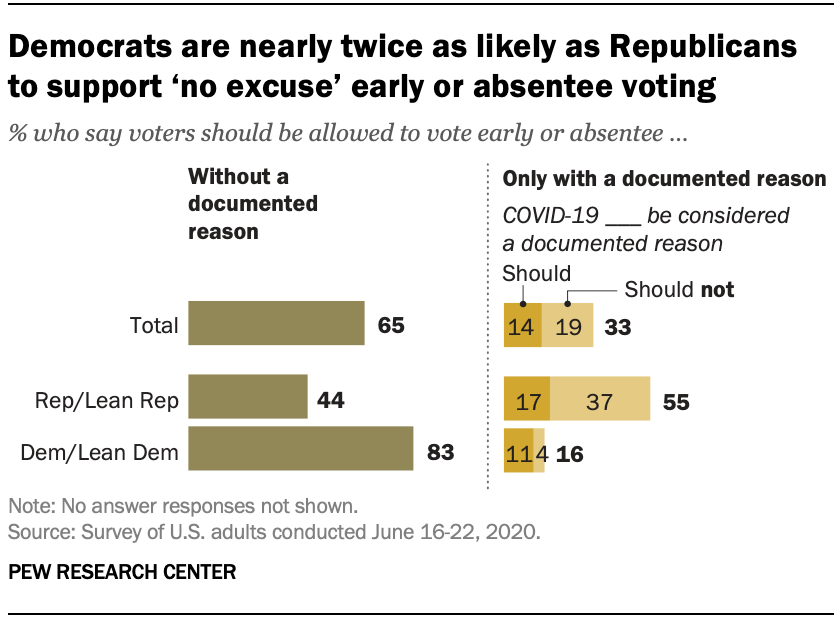
Support drops to 59% in states where voters must request a mail-in ballot without an excuse, and further to 53% in states that require a valid excuse to vote by mail.
These trends appear across party lines. Republicans in universal mail-in states are slightly more likely to favor no-excuse voting than those in other states, at 40% compared to 33%.
Which demographic groups support no-excuse voting?
Support for no-excuse voting varies by race, age, and education. Black adults are the most likely to support the option, at 76%, according to the survey. Support is lower among Asian (63%), Hispanic (62%), and White (55%) adults.
Age and education also correlate with these views. Adults under 50 are more likely to support no-excuse voting than those 50 and older (61% vs. 56%). Additionally, two-thirds of Americans with a bachelor’s degree or higher favor the practice, compared to 53% of those with a high school degree or less.
Does easier registration affect election security?
A May 2024 Pew Research Center survey found that 58% of Americans believe elections would not be less secure if rules were changed to make it easier to register and vote. However, 40% believe such changes would decrease security.
The divide is starkest among Republicans. According to the 2024 data, 63% of Republicans say making it easier to register and vote would make elections less secure. In contrast, 79% of Democrats say it would not.
Among specific ideological groups, 69% of conservative Republicans believe security would decrease, while 91% of liberal Democrats believe it would not.
What may happen next with voting access?
Given the widening partisan gap, future state-level legislation may continue to diverge based on party control. States could see a possible next step of either expanding universal mail-in access or implementing stricter excuse requirements.
Because support for no-excuse voting is higher in states that already offer it, existing laws may reinforce current public opinions over time. Legislative debates are likely to focus on the trade-off between the 58% of citizens who see no security risk and the 40% who do.
Frequently Asked Questions
What percentage of Americans support no-excuse early or absentee voting?
According to a Pew Research Center survey from April 2026, approximately 59% of U.S. adults support this option.
How have Republican views on no-excuse voting changed since 2018?
Support among Republicans dropped from a 57% majority in 2018 to 34% in 2026.
Do Americans believe easier voting rules impact election security?
According to a 2024 survey, 58% say elections would not be less secure, while 40% believe they would be.
How do you feel about the requirement to provide a documented reason for absentee voting?