
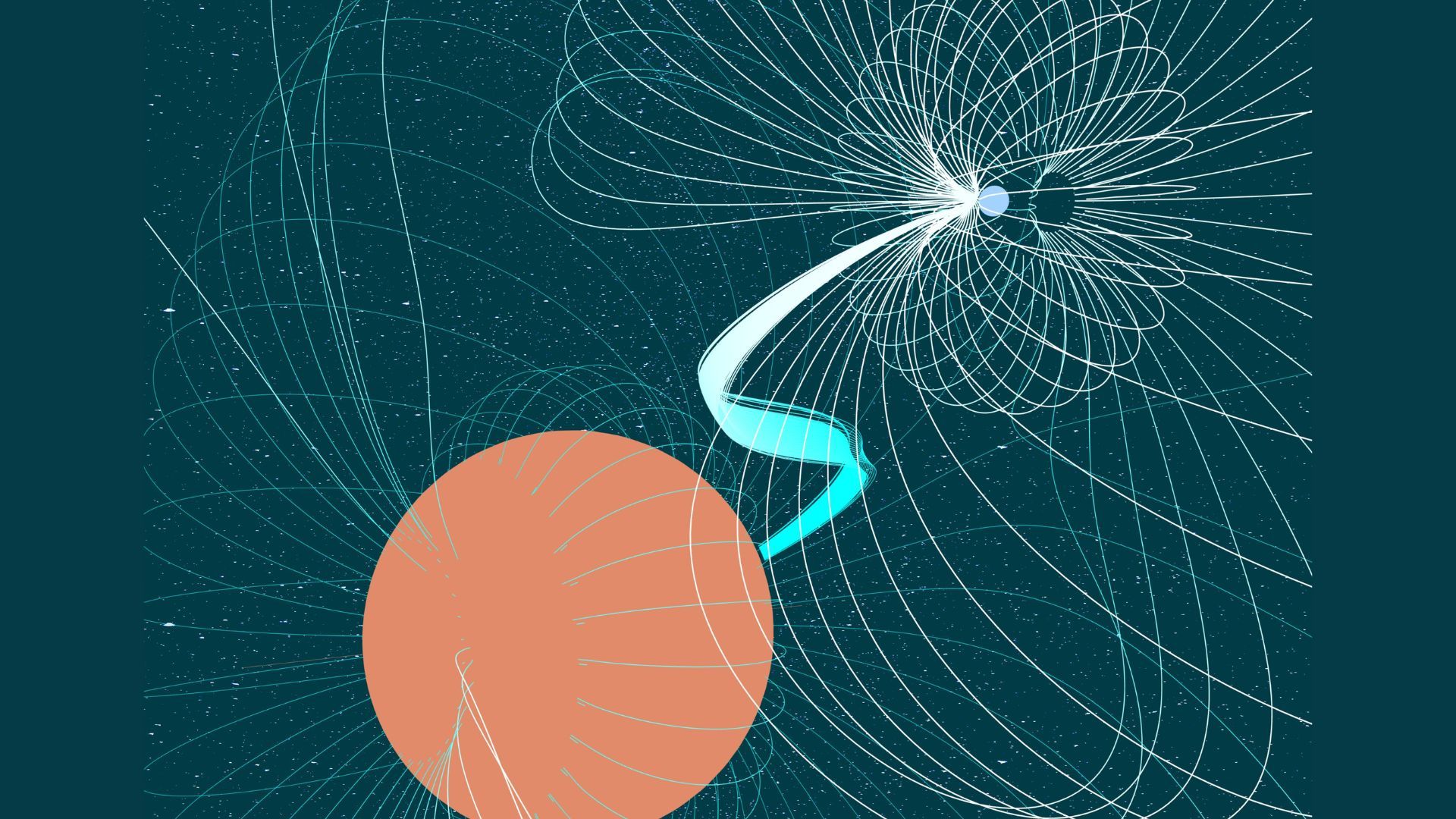
Mysterious repeating radio signal traced to ‘vampire’ star that’s slowly eating its companion
Decoding the Universe: The New Era of Cosmic Signal Hunting
For years, radio astronomers have been haunted by “long-period transients” (LPTs)—mysterious bursts of energy that flicker across the void every few minutes or hours. Unlike the rapid-fire pulses of fast radio bursts, these signals are slow, rhythmic, and stubbornly difficult to categorize.
The recent identification of ASKAP J1745−5051 has changed the game. By confirming this system as a magnetic cataclysmic variable—essentially a “vampire” white dwarf stripping material from a companion star—scientists have found a cosmic Rosetta Stone. This discovery doesn’t just explain one object; it provides a blueprint for decoding a whole class of celestial anomalies.
The Shift Toward Multi-Messenger Astronomy
One of the most significant trends emerging from the study of ASKAP J1745−5051 is the move away from “single-lens” observation. For decades, astronomers often relied on one type of data—either radio waves or optical light. The breakthrough here came from combining radio telescope data (via the Australian SKA Pathfinder) with X-ray observations (via the Einstein Probe).
The future of deep-space exploration lies in this synergy. By noticing that radio and X-ray peaks occur at different times, researchers can map the physical architecture of a distant system. We can now pinpoint where magnetic fields interact and where material is being heated to millions of degrees.
Expect future missions to prioritize “simultaneous observation,” where multiple satellites and ground-based arrays lock onto a single transient event to create a 3D understanding of the physics at play. For more on how these arrays work, check out Nature Astronomy’s latest research on stellar transients.
Big Data: Sifting Through Millions of Signals
The discovery of this “Rosetta Stone” wasn’t a stroke of luck; it was a triumph of data processing. Lead researcher Kovi Rose analyzed over 3 million radio sources, narrowing them down to just 100 candidates with circular polarization.
This highlights a massive trend in astrophysics: the transition from observation to data mining. As telescopes like the Square Kilometre Array (SKA) come online, the volume of data will be too vast for human eyes to scan. The future belongs to AI-driven filters and machine learning algorithms capable of spotting “the needle in the haystack.”
Redefining the ‘Life Cycle’ of Binary Systems
The confirmation of an accreting system as the source of LPTs forces us to rethink how binary stars evolve. ASKAP J1745−5051 is significantly brighter than previously observed cataclysmic variables, suggesting there may be a “hidden” population of high-energy binaries that we simply haven’t had the tools to detect until now.
We are likely entering a period where we will discover that many “unexplained” cosmic signals are actually the result of stellar cannibalism. This provides a natural laboratory to study extreme physics—gravity, magnetism, and plasma dynamics—that cannot be replicated in any lab on Earth.
As we refine our understanding of these “vampire stars,” we can better predict the final stages of stellar evolution, including the precursors to Type Ia supernovae, which are critical for measuring the expansion of the universe. You can read more about the evolution of binary systems in our comprehensive archive.
Frequently Asked Questions
What is a Long-Period Transient (LPT)?
LPTs are cosmic radio sources that emit strong pulses of radiation every few minutes or hours, with each burst lasting only a few seconds. They are much slower than fast radio bursts (FRBs).
Why is ASKAP J1745−5051 called a ‘Rosetta Stone’?
Because We see the first LPT confirmed to be a magnetic cataclysmic variable. This gives astronomers a known reference point to identify and understand other similar signals in the universe.
What is a magnetic cataclysmic variable?
It is a binary star system consisting of a white dwarf with a powerful magnetic field that pulls material away from a nearby companion star (usually a red dwarf).
How is this different from a pulsar?
While both emit periodic pulses, pulsars are rapidly rotating neutron stars. ASKAP J1745−5051 is a binary system where the periodicity is driven by the orbital “dance” of two stars and the interaction of their magnetic fields.
Join the Conversation
Do you think we’ll find more “vampire stars” in our own galactic neighborhood, or are these anomalies rare gems of the deep cosmos? Let us know your thoughts in the comments below or subscribe to our newsletter for weekly deep-dives into the mysteries of the universe!