
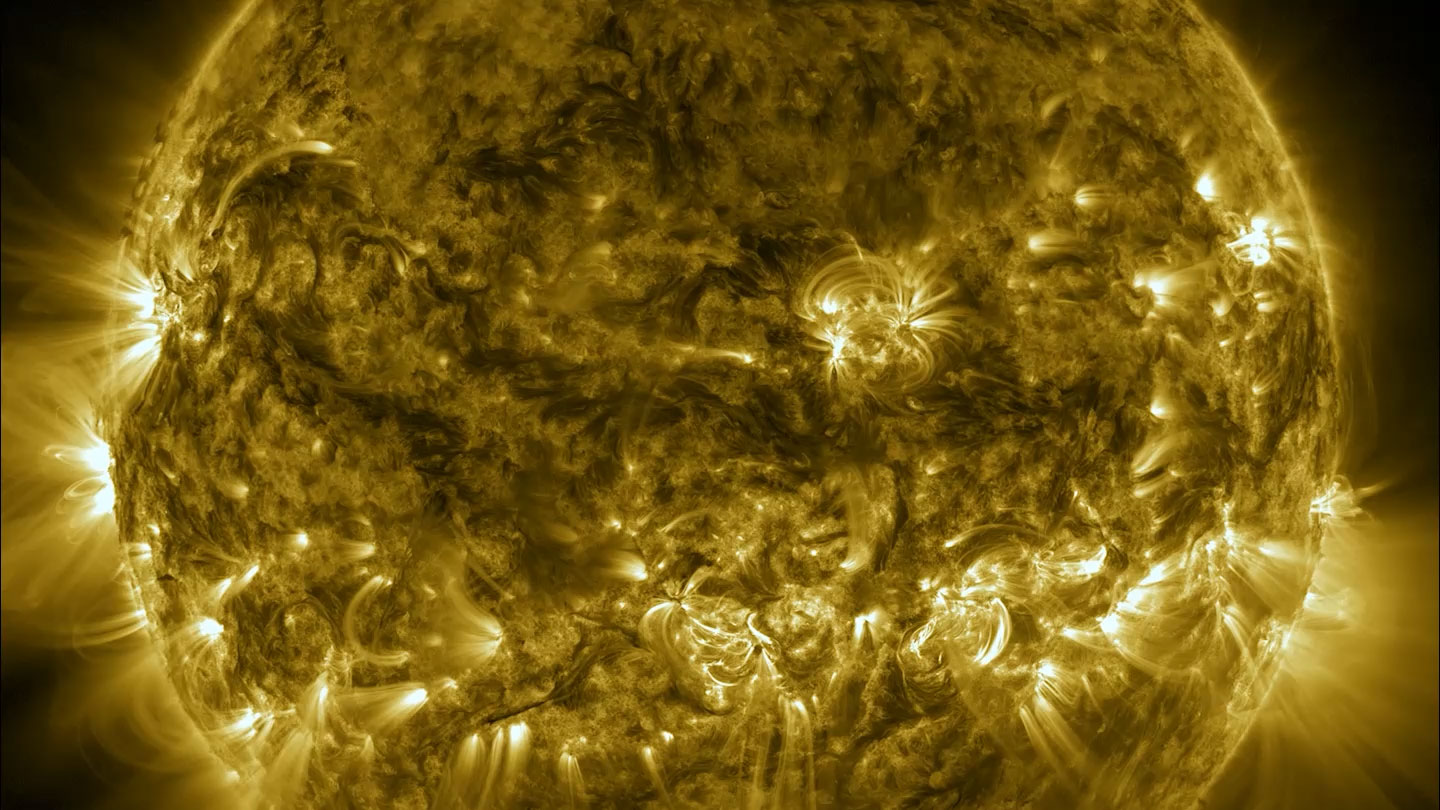
New Warning Signs Could Help Predict Solar Flares
Scientists have discovered that the sun may exhibit specific warning signs hours before a massive solar eruption. These observations, detailed in a paper submitted May 8 to arXiv.org, reveal changes near the solar surface that begin three hours before a flash occurs.
This discovery is critical for developing methods to predict future solar flares. Such capabilities could provide essential time to protect orbiting satellites, Earth’s power grid, and astronauts in space.
Tracking the Lead-Up to Eruption
Solar physicist Louis Seyfritz of the New Jersey Institute of Technology in Newark emphasizes that the primary goal of studying “pre-flaring” is protection. Predicting these events allows experts to shield astronauts from harmful radiation.
To study this, researchers used NASA’s Interface Region Imaging Spectrograph space telescope. They focused on a single point in an active region that had previously emitted a strong flare and eventually produced an X-class flare on October 3, 2024.
The telescope monitored light emitted by the silicon IV ion. This specific ion traces plasma within the transition region located between the sun’s surface and its corona.
The Mechanics of a Solar Trigger
The research team analysed the plasma’s turbulence, temperature, and its movement toward or away from the solar surface. All three parameters began to increase gradually three hours before the eruption as energy accumulated.
Approximately 20 minutes before the flare, researchers observed a jump in temperature and turbulence, as well as an increase in the speed of plasma moving away from the sun.
The team also identified periodic oscillations occurring every 8 and 20 minutes. In the final hour before the flare, tracers for turbulence and temperature began changing in synchronization.
Potential Challenges and Next Steps
Solar physicist Emily Mason of Predictive Science Inc. Suggests that these oscillations might hint at two different physical mechanisms in the plasma. Shorter wavelengths showed an 8-minute period, while longer wavelengths showed a 15-minute period.
A possible next step for researchers is to determine if these same oscillations appear in active regions that do not eventually erupt. This would help verify if the patterns are reliable predictors.
the ability to use these findings in a predictive capacity may depend on the development of new technology. A mission that can observe the whole sun at once could be necessary to make these predictions useful.
Frequently Asked Questions
What changes were observed before the solar flare?
Researchers found that plasma temperature, turbulence, and movement away from the sun’s surface increased gradually starting three hours before the flare, with a significant jump occurring 20 minutes before the event.
How could this research benefit astronauts?
If scientists can predict when a huge solar flare is going to happen, they may be able to protect astronauts from harmful radiation.
What is hindering the immediate use of these predictions?
Practical hurdles include the need for a mission that can observe the whole sun at once and conduct analysis onboard, which is currently a matter of funding.
How do you view the balance between funding deep-space exploration and the infrastructure needed to protect those already in space?