
NVIDIA Research Advances Physical AI Through Sim-to-Real Robotics
Beyond the Script: The Rise of Embodied Autonomy
For decades, industrial robotics has been a game of precision and repetition. We built robots that could perform a single task—like welding a car door—with micron-level accuracy, provided nothing in their environment ever changed. But the world is messy, unpredictable, and dynamic. The industry is now pivoting from “scripted automation” to embodied autonomy.
The goal is no longer to program a robot to move from Point A to Point B, but to teach it to understand the environment and reason through the best way to achieve a goal. This shift is being powered by “sim-to-real” transfer—the process of training an AI in a high-fidelity virtual world and deploying that intelligence into a physical machine.
Breaking the “Body Barrier” in Robot Navigation
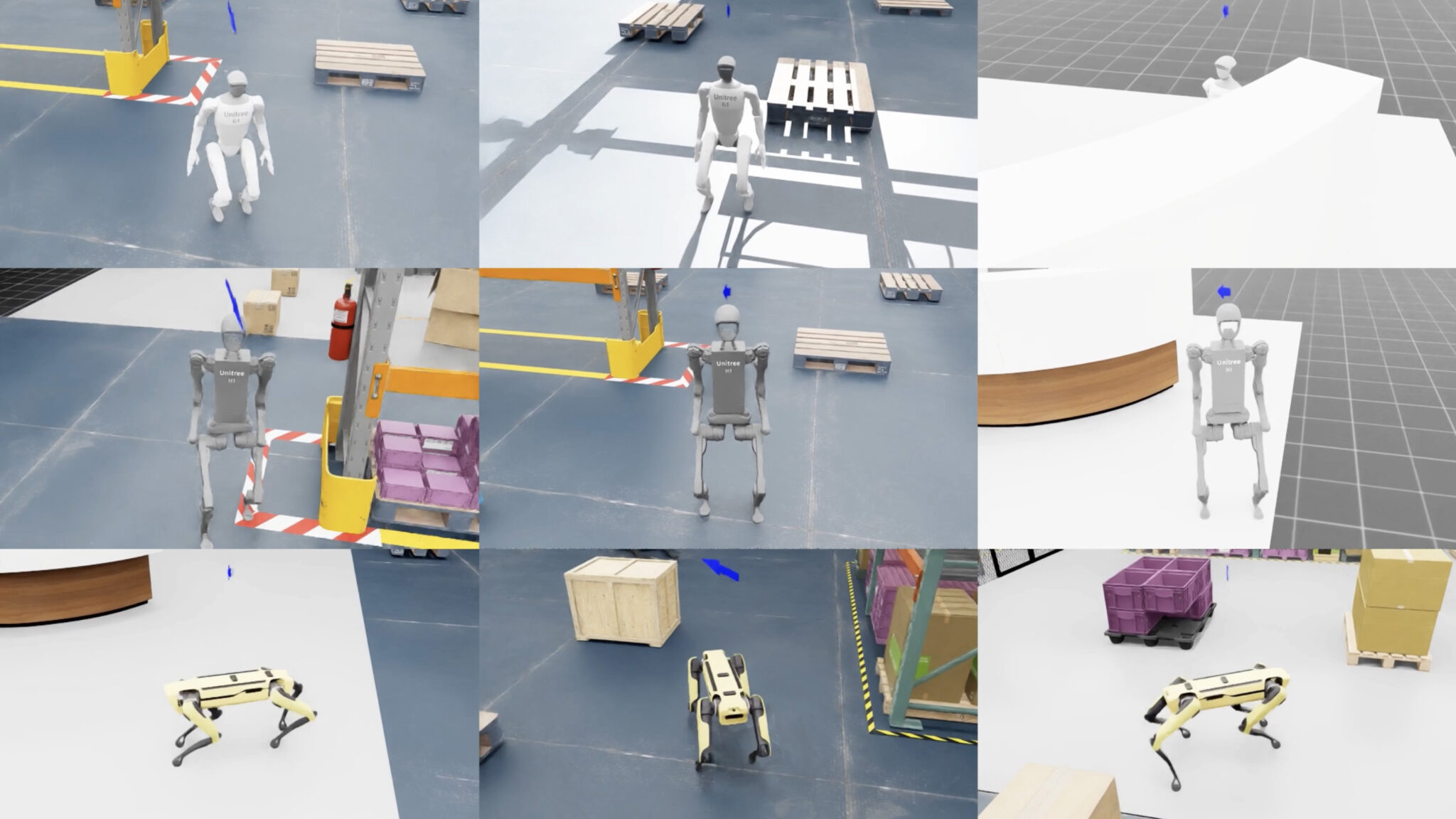
One of the biggest hurdles in robotics has been the “body problem.” Traditionally, if you trained a navigation policy for a four-wheeled robot, that software was useless if you moved it into a humanoid or a bipedal machine. The physics of movement—the embodiment—differed too much.
Emerging frameworks like COMPASS are changing this. By using imitation learning and residual reinforcement learning, developers can now create baseline navigation skills that generalize across diverse robot bodies. Which means a “brain” trained in a simulator can be dropped into various hardware configurations and still function effectively.
The data speaks for itself: early implementations have shown a 4.5x improvement in average success rates compared to traditional imitation learning, achieving roughly 80% success in real-world trials across both mobile robots and humanoids. We are moving toward a future where “robot software” is hardware-agnostic.
From Rigid Grips to Fluid Dexterity
If you’ve ever tried to pick up a tangled bunch of charging cables or a cluster of tree branches, you know it requires more than just a “pinch” motion. It requires a feel for the material. Most robots struggle with this because they rely on fixed paths rather than adaptive corrections.
The next frontier is adaptive grasping. New methods, such as Grasp-MPC, allow robots to continuously correct their motion as they close in on an object—mimicking how humans use tactile feedback. This approach has already boosted real-world grasping success rates from a baseline of 41% to roughly 75% for novel objects in cluttered spaces.
we are seeing the rise of “cluster manipulation.” Instead of focusing on a single object, robots are being trained to handle deformable materials—like clearing brush from power lines—by using their entire arm to sweep and gather, rather than just the gripper. This opens the door for massive advancements in autonomous agricultural and utility maintenance.
The Future of Precision Assembly: Learning from Error
High-precision tasks—like threading a nut onto a bolt—are the “final boss” of robotics. In a simulator, surfaces are perfectly smooth; in the real world, friction, dust, and microscopic misalignments cause failure.
The trend is moving toward a two-layer learning system. The first layer learns the general strategy in simulation (the “what to do”), while a second, hardware-specific layer learns to correct for real-world discrepancies using onboard cameras (the “how to adjust”).
This hybrid approach has demonstrated a 38% increase in success rates and a 30% reduction in cycle time. When applied to unseen tasks, such as those defined by the National Institute of Standards and Technology (NIST), these systems are beginning to approach the performance of humans-in-the-loop, signaling a future where fully autonomous, high-precision factories are viable.
VLA Models: When Robots Actually “Understand” Instructions
The most exciting evolution is the integration of Vision-Language-Action (VLA) models. For years, robots have been “blind” to the context of their instructions. If you told a robot to “find the banana,” it would process every single pixel in the room, often getting distracted by irrelevant noise.
New pipelines like PEEK are introducing a “focus” mechanism. By using a vision-language model to annotate the scene, the robot can fade out the background and highlight only the objects relevant to the task. In some simulation-trained policies, this has resulted in a staggering 41x improvement in real-world accuracy.
But reasoning is only half the battle; execution is the other. The industry is now solving “action misalignment”—where a robot reasons correctly but executes the wrong move. By generating multiple candidate action sequences and picking the one that matches the intended outcome (a method known as SEAL), robots are becoming significantly more robust against scene clutter and shifted camera angles.
Frequently Asked Questions
What is sim-to-real transfer?
It is the process of training an AI agent in a simulated environment (like NVIDIA Isaac Sim) and then transferring that learned policy to a physical robot in the real world.
Why is embodied autonomy better than scripted automation?
Scripted automation requires a fixed environment and specific instructions. Embodied autonomy allows a robot to perceive its surroundings, reason through a problem, and adapt its actions to unpredictable changes.
Can one AI “brain” work on different types of robots?
Yes. New frameworks are enabling “generalizable policies” that allow navigation and manipulation skills to be transferred across different robot embodiments (e.g., from a wheeled robot to a humanoid).
How do VLA models help robots?
Vision-Language-Action models allow robots to translate natural language instructions into physical movements by reasoning about the visual scene, effectively bridging the gap between “thinking” and “doing.”
Stay Ahead of the AI Revolution
The line between the digital and physical worlds is blurring. Want to dive deeper into the world of Physical AI and robotics?