
OpenAI Launches Lockdown Mode to Prevent Data Leaks and Prompt Injection
OpenAI is shifting toward a “hardened” security model with its new Lockdown Mode, which blocks web access and file downloads to prevent prompt-injection attacks. This move responds to warnings from the UK AI Safety Institute and CISA about AI vulnerabilities, signaling a future where corporate AI security and government oversight take precedence over raw functionality.
Why did OpenAI launch Lockdown Mode?
OpenAI introduced Lockdown Mode to stop attackers from using prompt-injection to extract sensitive data from AI systems. It’s an optional feature available to everyone, from free users to enterprise clients, accessible via the “Advanced Security” menu.
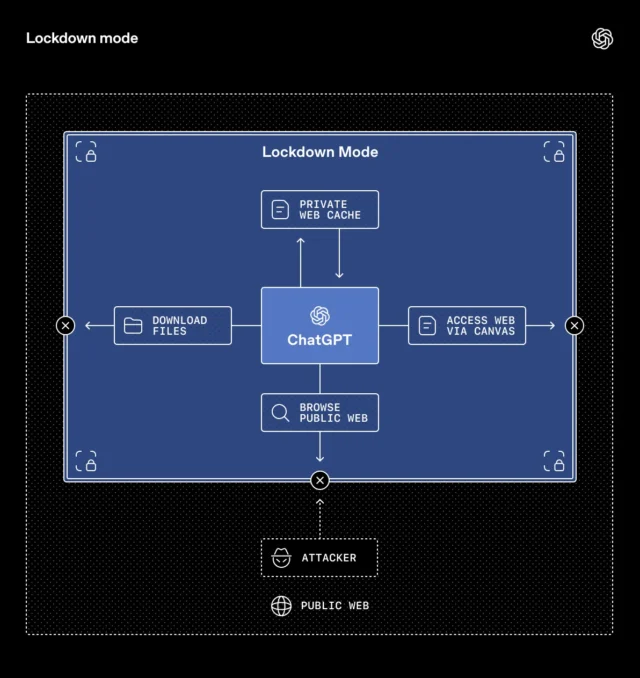
When active, the AI becomes a closed system. It kills live web access and disables high-power tools like Deep Research, Agent Mode, and the Canvas network. It also blocks file downloads to prevent automated data leaks, though users can still upload files and generate images.
This represents a significant pivot. For a long time, the race was about adding more “agents” and capabilities. Now, OpenAI is admitting that these same capabilities are the primary attack vectors for hackers. We’re seeing the birth of “Air-Gapped AI” for the corporate world.
Is AI actually a security risk for businesses?
Yes, and the risks are becoming concrete. According to a former advisor to the US Cybersecurity and Infrastructure Security Agency (CISA) testifying before the US House of Representatives, AI models can identify software vulnerabilities faster than humans can patch them. He argued for a “Secure-by-Design” approach rather than fixing flaws after the model is deployed.

The UK AI Safety Institute in London backed this up through “red-teaming” exercises. Their tests showed that models from OpenAI, Google, and Anthropic remained susceptible to queries that could yield hacking instructions or blueprints for biological weapons. This isn’t just theoretical; it’s a systemic weakness in how Large Language Models (LLMs) process instructions.
How will the EU AI Act and the Great American AI Act change AI?
Regulation is moving from “suggestions” to “mandates.” The EU AI Act already establishes a legal framework that forces companies to categorize AI by risk levels and maintain strict documentation. This means “black box” AI is no longer acceptable for business use in Europe.
Across the Atlantic, US lawmakers have introduced a discussion draft for the Great American Artificial Intelligence Act. This proposed law targets the giants. Any AI developer with over $500 million in revenue would be required to submit their security frameworks for certification by independent third-party auditors.
We’re moving toward a world where an AI model will need a “security certificate” before it can be sold to a Fortune 500 company, much like how aircraft or medical devices are certified today.
What does government involvement mean for OpenAI’s future?
OpenAI isn’t just fighting hackers; it’s negotiating with power. Company executives are currently in talks with the White House regarding potential state participation in the company. With a valuation sitting around $850 billion, OpenAI is becoming “too big to fail” or, more accurately, “too powerful to be purely private.”
If the US government takes a stake or a formal role in OpenAI’s governance, the priority of the AI will shift. We can expect a tighter alignment with national security interests, which likely means even more restrictive “Lockdown” features and closer integration with federal cybersecurity standards.
Comparing the Security Approaches
| Approach | Method | Trade-off |
|---|---|---|
| Patch-work | Updating filters after a leak is found. | High risk of “zero-day” exploits. |
| Lockdown Mode | Disabling dangerous features entirely. | Loss of utility and “agent” power. |
| Secure-by-Design | Building security into the core architecture. | Slower development and higher costs. |
Frequently Asked Questions
Does Lockdown Mode stop me from using DALL-E?
No. Image generation and manual file uploads remain active even when Lockdown Mode is enabled.
Can I turn off Lockdown Mode for just one chat?
Yes. While you can set a global preference in “Advanced Security,” you can deactivate it on a per-session basis if you need web access for a specific task.
Is Lockdown Mode compatible with Developer Mode?
No, these two features are currently incompatible.
What is the main goal of the Great American AI Act?
It aims to force high-revenue AI developers to undergo independent security audits to ensure their models don’t pose a systemic risk to national infrastructure.
What’s your take? Would you sacrifice the “magic” of an AI agent—like its ability to browse the web and execute tasks—for a guarantee that your data is locked down? Let us know in the comments or subscribe to our newsletter for more deep dives into the intersection of AI and cybersecurity.