
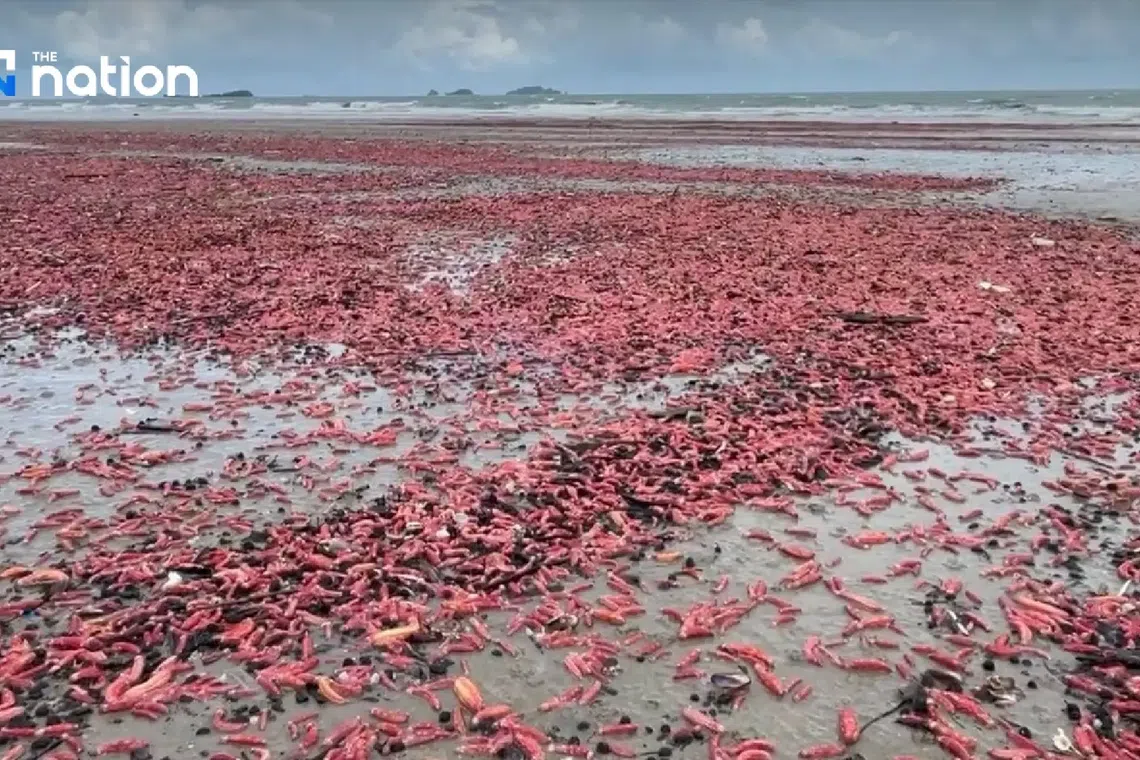
Pink sea cucumbers wash ashore, turning Thailand beach reddish-pink
Thousands of pink sea cucumbers (Cercodemas anceps) recently blanketed Suan Son Beach in Rayong, Thailand, creating a rare, vibrant pink shoreline that sparked immediate government inspections. According to the Ministry of Natural Resources and Environment, this mass stranding is a natural phenomenon linked to turbulent weather and strong waves, which displaced the bottom-dwelling invertebrates from their seabed habitat.
Why do sea cucumbers wash ashore in large numbers?
Sea cucumbers are typically sedentary creatures, but extreme weather events can force them out of their stable environments. According to the Department of Marine and Coastal Resources (DMCR), the primary cause of the Rayong incident was intense wave action and storm surges. These forces act like a vacuum, lifting seabed-dwelling organisms and depositing them along the coastline.
Sea cucumbers are often called the “housekeepers of the sea.” They ingest organic matter and sediment, effectively recycling nutrients on the ocean floor and maintaining the health of the marine ecosystem.
Is it safe to touch the pink sea cucumbers?
Officials at the DMCR strongly advise tourists and locals to avoid direct contact with the stranded animals. While Cercodemas anceps is not inherently lethal to humans, these invertebrates have a biological defense mechanism. When stressed or disturbed, they may release chemical substances that can cause skin irritation or allergic reactions in sensitive individuals.

What are the long-term environmental implications?
The appearance of these creatures serves as a tangible indicator of seabed biodiversity, yet it also highlights the vulnerability of coastal ecosystems to climate-related shifts. Increased frequency of storm surges—often cited by organizations like the Intergovernmental Panel on Climate Change (IPCC) as a consequence of warming oceans—may lead to more frequent “uncommon” strandings. Experts are currently monitoring the Rayong site to ensure that the mass death of these organisms does not lead to localized pollution or a spike in bacteria as the organic matter decomposes.
If you encounter a mass stranding of marine life, do not attempt to “rescue” them by dumping them back into the water without official guidance. Contact your local maritime authority or the Department of Marine and Coastal Resources to report the location and density of the event.
Future trends in coastal management
As extreme weather events become more frequent, coastal management is shifting toward “real-time surveillance.” Rather than reacting after the fact, agencies are looking into satellite and sensor-based monitoring to track changes in seabed populations. By integrating citizen science—where residents report anomalies via mobile apps—authorities hope to map the migration patterns of invertebrates more accurately, distinguishing between normal seasonal shifts and environmental distress signals.
Frequently Asked Questions
Are pink sea cucumbers poisonous?
Most are not poisonous, but they can release toxins as a defense mechanism when stressed. This can cause skin rashes or eye irritation, so it is best to observe them from a distance.
What should I do if I see a mass stranding at the beach?
Do not touch the animals. Take a photo, note the location, and report the incident to your local environmental agency or marine department so they can assess the cause.
Why is the beach turning pink?
The color is a result of the high concentration of Cercodemas anceps, which naturally range from bright pink to reddish-orange. When thousands wash up simultaneously, they physically cover the sand with their skin pigments.
Have you witnessed unusual marine activity on your local beach? Share your observations in the comments below or subscribe to our newsletter for the latest updates on coastal conservation and marine science.