
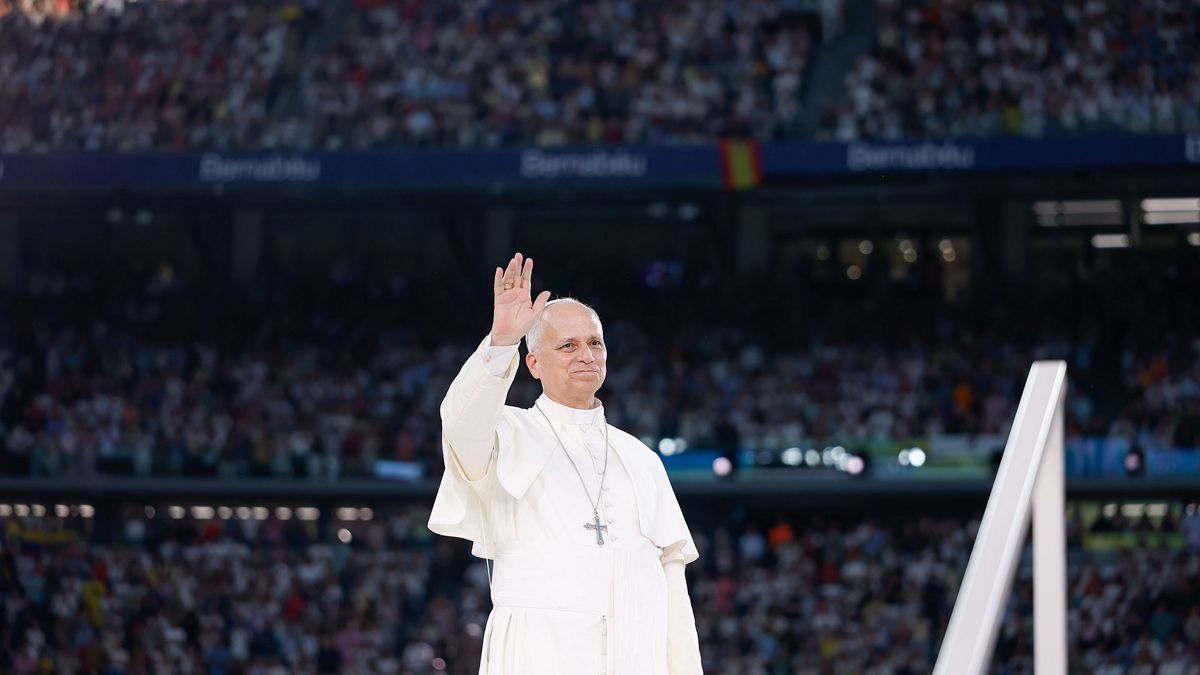
Pope Leon XIV Visits Santiago Bernabéu for Historic Event
Pope Leon XIV’s visit to the Santiago Bernabéu, which drew over 70,000 attendees, highlights a growing trend of using sports infrastructure for massive religious and cultural gatherings. By blending spiritual messages with high-production entertainment, the Vatican is adapting to the “experience economy” to reach diverse, urban audiences in secular spaces.
The Bernabéu isn’t just a football pitch anymore. It’s a multipurpose engine for mass mobilization. When Pope Leon XIV stood before the Madridista crowd, he didn’t just deliver a sermon; he participated in a curated event featuring a 1,000-voice choir and a symphony orchestra. This isn’t a fluke—it’s a blueprint for how large-scale institutions are fighting for attention in a distracted age.
Why are religious leaders moving into sports stadiums?
Traditional cathedrals have a ceiling—literally and figuratively. To reach 70,000 people at once, the Church needs the logistics of a modern stadium. According to the event records, the Bernabéu provided the necessary scale and technical infrastructure that a standard parish simply cannot offer.
We’re seeing a shift toward “sacred secularism.” By occupying a space synonymous with passion and victory, the religious message piggybacks on the emotional energy of the venue. Pope Leon XIV acknowledged this explicitly, noting that while players score goals for glory, the church was “scoring a goal for eternity.”
How does “faith-tainment” change the way people experience spirituality?
The event at the Bernabéu wasn’t a traditional Mass; it was a production. With hosts like Patricia Pardo and Christian Gálvez, and performances by artists like Íñigo Quintero and David Bustamante, the line between a religious service and a music festival blurred.
This “faith-tainment” model reflects a broader trend in global outreach. By integrating a magician like Jorge Blass and the Cruz Diez Symphony Orchestra, the Church is practicing “polyphony”—unity in diversity. It’s an admission that to keep people engaged, the delivery must be as polished as a Super Bowl halftime show.
This approach mirrors strategies used by other global entities to maintain relevance. For instance, the Real Madrid brand itself has evolved from a sports club into a global entertainment entity, making it the perfect partner for a modern papacy seeking visibility.
The Shift: 1982 vs. Today
Compare the 1982 visit of John Paul II to this recent event. The earlier visit was primarily a diplomatic and religious milestone. The current visit, however, is an immersive experience. We’ve moved from “the Pope is visiting” to “the Pope is hosting an event.” The focus has shifted from the authority of the office to the quality of the experience.
What happens when stadiums become spiritual hubs?
The success of this gathering suggests that we’ll see more “pop-up” spiritual centers in commercial venues. As urban centers become more secular, the “stadium-as-cathedral” trend allows institutions to meet people where they already congregate.
This has significant implications for urban planning and venue management. Stadiums are no longer just for 90 minutes of football; they are becoming civic centers for identity and belief. Florentino Pérez’s willingness to host such an event demonstrates that the Bernabéu is positioning itself as a global landmark for all types of human connection, not just athletic competition.
Future trends likely include more integrated tech—think AR experiences that explain the religious significance of the event in real-time to a global streaming audience. If you’re interested in how venues are evolving, check out our analysis on the evolution of smart stadiums.
Frequently Asked Questions
Who is Pope Leon XIV?
He is the pontiff who recently visited Spain, emphasizing unity in diversity and the intersection of faith and modern culture.
Why was the Bernabéu chosen for this event?
The stadium offers the capacity (70,000+ people) and the prestige necessary for a high-profile international visit, serving as a symbol of Madrid’s cultural heart.
What is “polyphony” in this context?
As described by the Pope, it refers to “unity in diversity,” using various artistic and musical forms to create a single, harmonious message of faith.
What do you think? Is the blending of religion and entertainment a smart way to reach new generations, or does it dilute the spiritual message? Let us know in the comments below or subscribe to our newsletter for more insights into the intersection of culture and power.