
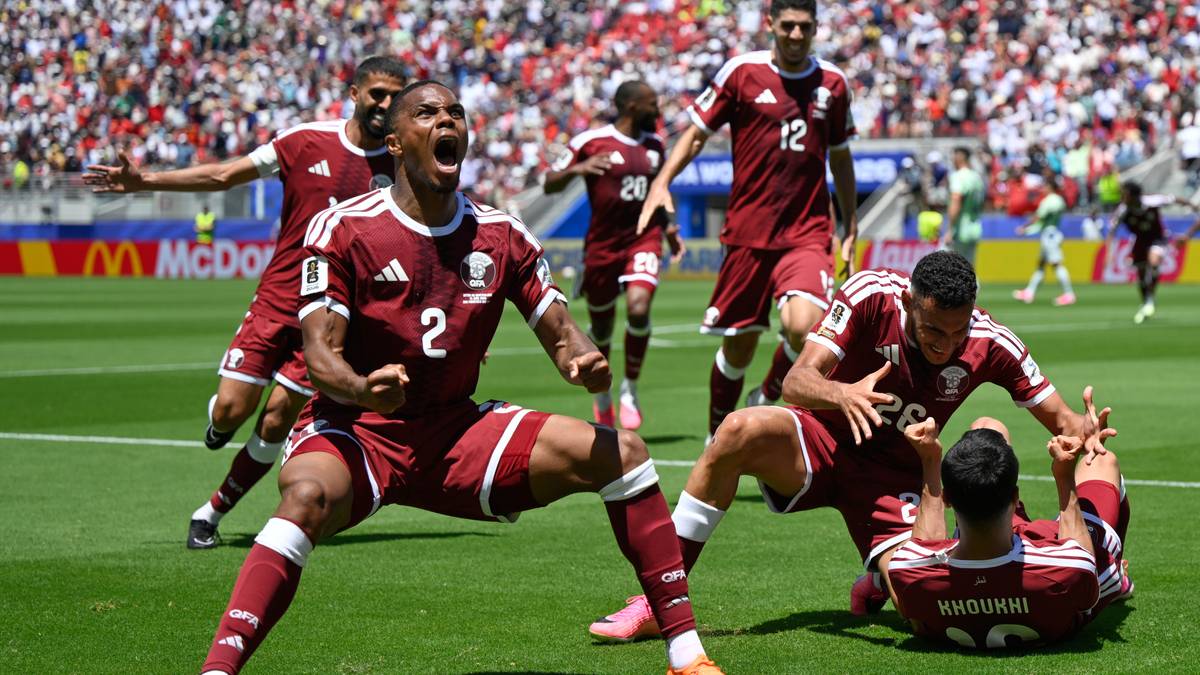
Qatar Makes History With First World Cup Point Against Switzerland
Qatar earned its first-ever World Cup point on June 13, 2026, after captain Boualem Khoukhi scored a header in the fifth minute of stoppage time to secure a 1-1 draw against Switzerland. This result marks the first time the nation has recorded a point in the tournament’s history, according to match reports.
How did Qatar secure its first World Cup point?
Captain Boualem Khoukhi, 35, scored the equalizing header deep into stoppage time. Expert commentator Carl-Erik Torp described the moment as a header that sent Qatar toward its “biggest sporting moment.”

The goal triggered widespread euphoria among the Qatari players. NRK expert Aleksander Schau compared the significance of the event to Kjetil Rekdal’s 1998 match against Brazil, suggesting the moment could lead to the creation of posters, murals, and statues in Qatar.
Torp noted that Switzerland appeared likely to win the match after dominating the early stages. However, Switzerland failed to secure a second goal, allowing Qatar to remain competitive until the final whistle.
Why was the Switzerland penalty controversial?
A penalty awarded to Switzerland led to a goal, but the decision sparked criticism from analysts regarding a potential offside. Gary Neville told the BBC that he believes the play was offside until proven otherwise.

Neville criticized both VAR and the broadcast production, stating that FIFA, as the broadcaster, possesses semi-automatic technology that should have provided clearer evidence. NRK football expert Kristoffer Løkberg also stated he could not see the Swiss player on the correct side of the ball.
Løkberg questioned why 3D technology, used elsewhere in the tournament, was not employed to provide a visual proof of the decision. He argued that the offside appeared clear to the naked eye and that a lack of evidence allows for continued debate.
What were the physical and emotional impacts of the match?
Qatar goalkeeper Mahmud Ibrahim Abunada suffered a significant blow to the head after a collision with a Swiss attacker’s knee in the first half. The collision resulted in the penalty awarded to Switzerland.
Abunada remained on the ground for several minutes. According to Andrine Hegerberg, such impacts to the head are particularly uncomfortable to witness, though Abunada continued the match after receiving treatment.
The final result left the Swiss squad visibly affected. Hegerberg observed that the players appeared “small-shocked,” describing their expressions as stiff and staring straight ahead rather than showing outward rage.
What may happen next for both teams?
Qatar could see a surge in national momentum following their first historical World Cup point. This result may influence their confidence in subsequent group stage matches.

Switzerland may face internal reviews of their defensive lapses in stoppage time. The team’s ability to recover from this draw could determine their progression in the tournament.
Frequently Asked Questions
Who scored the equalizing goal for Qatar?
The goal was scored by 35-year-old captain Boualem Khoukhi via a header in the fifth minute of stoppage time.
What was the controversy surrounding the Swiss goal?
Analysts Gary Neville and Kristoffer Løkberg questioned whether the play leading to the penalty was offside and criticized the lack of 3D VAR evidence provided by FIFA.
How did the Swiss players react to the 1-1 draw?
According to Andrine Hegerberg, the players appeared shocked and stiff, staring straight ahead without displaying outward anger on the pitch.
Do you think the lack of VAR transparency changes the way fans perceive the fairness of the World Cup?