
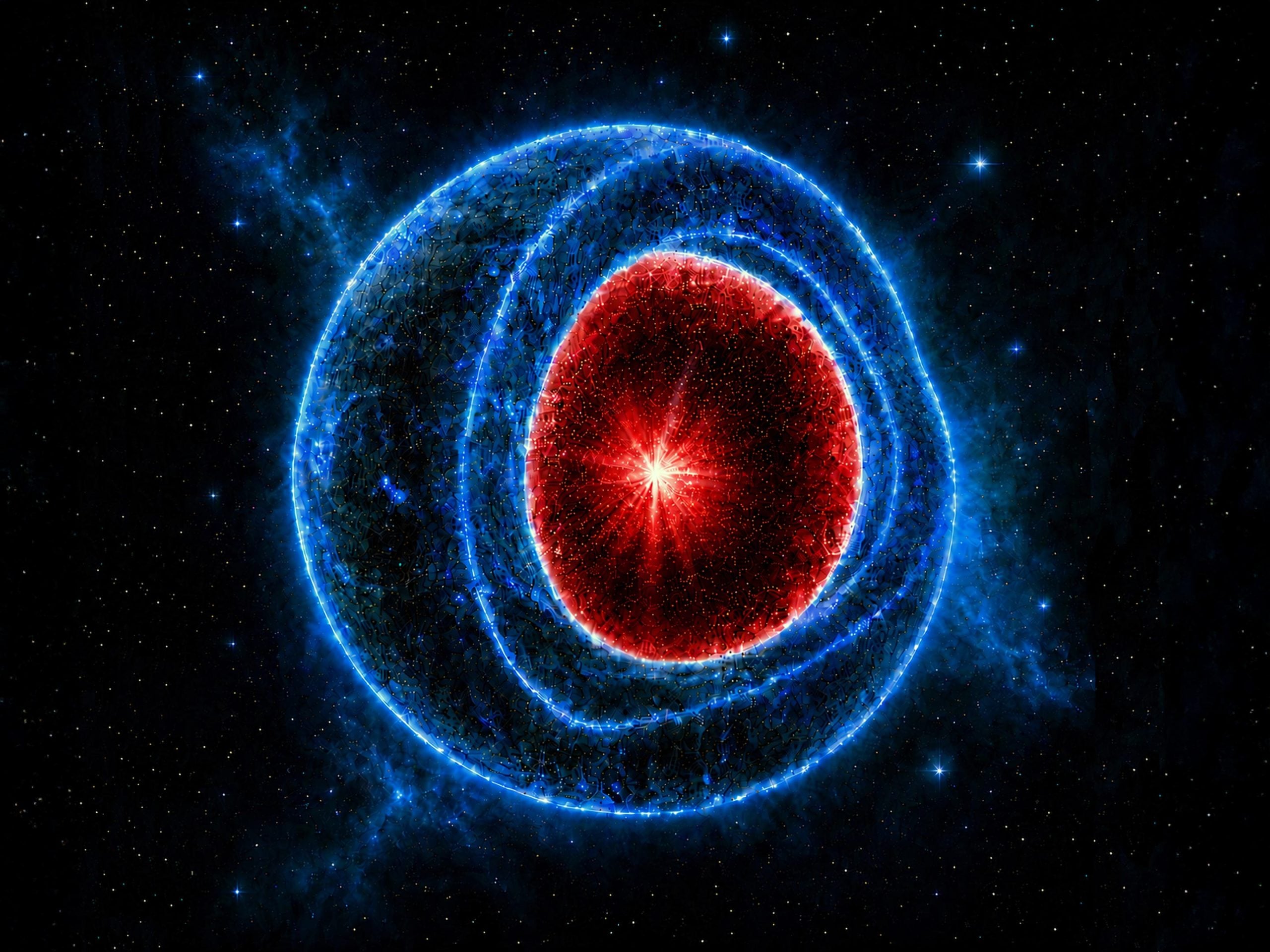
Scientists Say a New Universe Could Form Inside a Dying Star
A new study published in Physical Review D suggests that the gravitational collapse of a massive star may produce a stable object known as a gravastar rather than a black hole. Researchers Daniel Jampolski and Professor Luciano Rezzolla of Goethe University Frankfurt developed a dynamic solution to Albert Einstein’s equations of General Relativity, indicating that a miniature, expanding universe could emerge within the collapsing stellar matter to prevent the formation of a singularity.
The Gravastar Mechanism
The formation of a gravastar relies on the presence of dark energy within the interior of a collapsing star. According to Jampolski and Rezzolla, as a massive star exhausts its nuclear fuel and gravity forces an inward collapse, a mini-universe could emerge, mirroring the process of the Big Bang. This mini-universe generates outward pressure driven by dark energy, which opposes the gravitational pull. This counter-pressure creates a state of equilibrium, resulting in a stable object that avoids the infinite density of a singularity and the observation-blocking event horizon associated with black holes.
Did You Know? The concept of the gravastar, or gravitational vacuum star, has been a subject of theoretical debate for approximately 25 years as scientists have sought to understand how such objects might arise from the collapse of ordinary matter.
Scientific Implications and Context
Black holes are currently the widely accepted end state for massive stars, yet they present significant theoretical challenges. The mass of billions of suns compressed into a single point, combined with the extreme curvature of spacetime, makes the physics of a singularity difficult to predict. Furthermore, the event horizon hides all matter, energy, and light, making direct observation impossible. The gravastar model provides an alternative that retains the compactness of a black hole while incorporating ordinary matter in its outer layers and dark energy in its interior.
Expert Insight: While gravastars offer an intriguing theoretical alternative, they should not be viewed as a dismissal of black hole theory. Black holes remain the most straightforward solution to gravitational collapse. However, exploring exotic interpretations is essential for physicists to maintain an unbiased approach toward phenomena where the laws of physics are not yet fully understood.
Future Research and Observations
The study by Jampolski and Rezzolla establishes a mathematical framework for how these objects could form at the late stages of stellar collapse, when matter is under extreme compression. Future research may focus on identifying new physical effects that emerge under these conditions. Because gravastars are hypothesized to be ultra-compact and nearly impossible to observe due to intense gravity, detecting them will likely require advancements in our understanding of how matter behaves at the limits of compression.
Frequently Asked Questions
What is the primary difference between a black hole and a gravastar?
Unlike black holes, which contain a singularity and an event horizon, gravastars contain ordinary matter in their outer layers and dark energy in their interiors, preventing the formation of a singularity.
How does a gravastar remain stable?
A gravastar achieves stability through a balance between the inward pull of gravity and the outward pressure generated by the dark energy of an expanding mini-universe located within the star.
Is this study intended to disprove the existence of black holes?
No. According to Professor Luciano Rezzolla, the study represents an exploration of exotic alternatives and does not suggest skepticism toward black holes, which remain the most natural solution for gravitational collapse.
How might our understanding of the universe change if gravastars are proven to exist?