
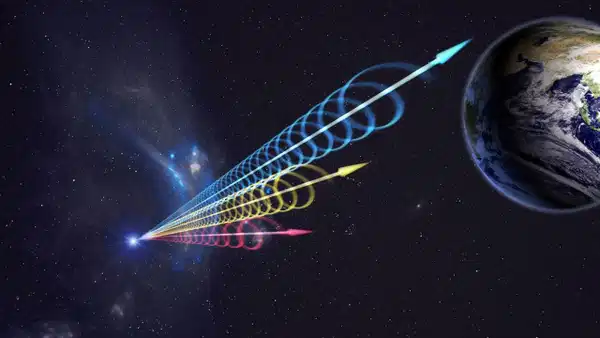
Scientists Uncover Source of Mysterious Deep Space Radio Signals
The Cosmic Mystery Solved: What Those “Alien” Radio Signals Really Are
For years, astronomers have been captivated—and occasionally unsettled—by mysterious, rhythmic radio signals pulsing from the depths of the Milky Way. Every 1.4 hours, a repeating burst would hit our detectors, leading many to speculate about the possibility of extraterrestrial intelligence trying to make contact.
However, science has once again replaced science fiction with a more elegant, albeit equally fascinating, reality. Researchers have finally identified the source of these “long-period radio transients,” and the answer lies in a high-stakes celestial dance between two stars.
The Anatomy of a Cosmic Lighthouse
The mystery centers on a specific system known as ASKAP J1745−5051. Rather than an advanced civilization, we are looking at a binary star system—a violent, beautiful interaction between a dense “white dwarf” and its larger, less dense companion star.
As the white dwarf strips matter away from its neighbor, that material spirals inward, heating up to extreme temperatures. This process releases a cocktail of X-rays and powerful radio waves. It’s essentially a cosmic engine, operating with enough precision to mimic the appearance of a signal, but powered by gravity and magnetic fields rather than technology.
White dwarfs are the final evolutionary state of stars like our Sun. They are incredibly dense—a teaspoon of white dwarf material would weigh about as much as an elephant!
Why This Discovery Matters for Future Astronomy
For a long time, the scientific community leaned toward the theory that these signals were produced by slow-rotating neutron stars, or pulsars. However, the math never quite added up; the rotation speeds required were theoretically impossible for such objects.
This breakthrough, recently published in Nature Astronomy, shifts our understanding of stellar evolution. By identifying these white dwarf systems, astronomers can now categorize the roughly 12 similar events detected so far, effectively clearing up a massive backlog of “unknown” celestial phenomena.
The Future of Deep Space Monitoring
What does this mean for the future of space exploration? As our radio telescope technology—like the ASKAP (Australian Square Kilometre Array Pathfinder)—becomes more sensitive, we are going to find thousands more of these “transients.”
- Automated Classification: AI-driven algorithms will soon classify these pulses in real-time, filtering out natural “noise” to focus on truly anomalous signals.
- Mapping the Galaxy: By studying how these signals interact with interstellar space, scientists can map the density of gas and dust in the Milky Way with unprecedented accuracy.
- Refined Search for ET: By understanding the “natural” background noise of our galaxy, People can better isolate signals that actually deviate from natural physics.
If you want to stay updated on the latest deep-space discoveries, follow the NASA Exoplanet Archive or the European Southern Observatory for real-time news on astronomical transients.
Frequently Asked Questions
- Could these signals still be from aliens?
- While we can never rule out the unknown, we now have a proven, natural explanation for these specific signals that fits the data perfectly. There is no longer a need to invoke extraterrestrial technology to explain them.
- How many of these signals have been found?
- To date, scientists have identified approximately 12 of these “long-period” radio transients in the Milky Way.
- Why are they called “transients”?
- In astronomy, a “transient” refers to an object or event that appears, changes, or vanishes over a short period of time, as opposed to a permanent feature like a static star.
What do you think? Does the reality of a white dwarf system make the universe feel less lonely, or were you hoping for a signal from the stars? Share your thoughts in the comments below or subscribe to our newsletter for more deep-space insights delivered to your inbox.