
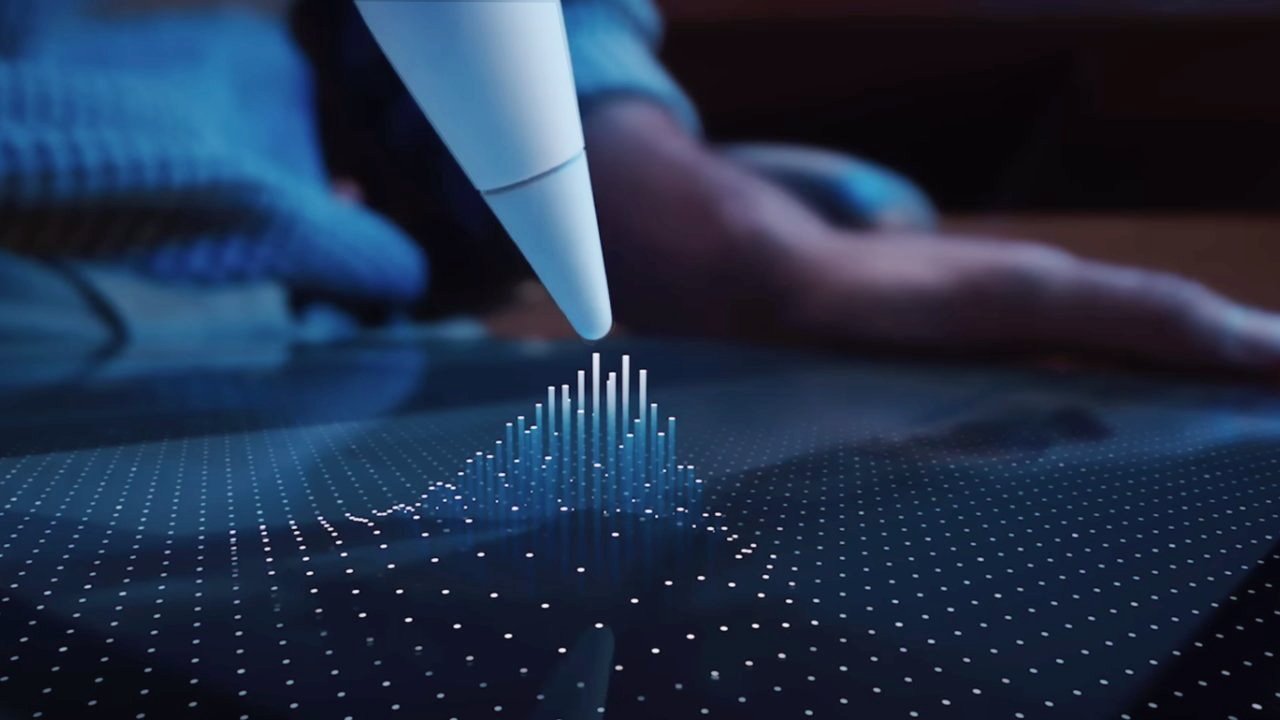
Texture-sensing Apple Pencil accessory for Apple Vision Pro
The End of the “Ghost Touch”: Why Feeling Virtual Objects Changes Everything
For years, virtual reality has had a glaring weakness: the “ghost touch.” You can see a hyper-realistic 3D model of a marble statue or a piece of rough sandpaper in your headset, but the moment you reach out to touch it, your hand passes through thin air. The illusion breaks instantly.
Apple’s latest patent for a haptic-enabled stylus suggests we are moving toward a world where “seeing is believing” is replaced by “feeling is believing.” By integrating linear actuators and gyroscopes into a Pencil-like device, Apple isn’t just making a tool for artists—they are attempting to solve the sensory gap in spatial computing.
From Vibrations to Textures: The Tech Behind the Magic
Most current haptics rely on simple vibration motors (ERM or LRA). They tell you that something happened, but not what it feels like. Apple’s proposed system goes deeper, using a combination of sensors and actuators to mimic friction and roughness.

The magic lies in the “linear actuator.” Imagine a tiny piston that can extend or contract almost instantaneously. By varying the frequency and force of these movements, the device can trick your nerves into feeling the grit of sandpaper or the smoothness of glass.
the inclusion of a gyroscope allows the device to change the sensation based on the angle of your hand. If you tilt the stylus, the “friction” changes, mirroring how we interact with physical objects in the real world. This is a critical step toward true haptic fidelity.
The Battle of Ergonomics: Stylus vs. Gloves
Industry insiders have long debated the best way to deliver tactile feedback. Haptic gloves—like those seen in high-end industrial simulations—offer the most immersion but are cumbersome, hot and difficult to put on.
A stylus is a “low-friction” entry point. It’s an accessory you can pick up and put down in seconds. For professionals in spatial computing, a precision tool is far more valuable than a bulky glove, especially for tasks requiring fine motor skills like 3D sculpting or surgical planning.
Beyond Gaming: Real-World Applications of Tactile XR
While the average consumer might use this to “feel” a virtual fabric while shopping online, the enterprise implications are where the real disruption happens.
1. Medical Training and Telemedicine
Imagine a medical student practicing a delicate procedure on a virtual patient. With a haptic stylus, they could feel the difference between a vein and a ligament, providing a level of muscle memory that a visual-only simulation cannot offer.
2. Industrial Design and Prototyping
Engineers currently spend thousands of dollars on 3D-printed prototypes just to test the “feel” of a button or a grip. A haptic-enabled Vision Pro setup would allow designers to iterate on the tactile ergonomics of a product in a purely virtual space, slashing R&D costs.
3. Digital Art and High-Fidelity Sculpting
For creators, the ability to feel the “resistance” of virtual clay or the “drag” of a brush on a canvas would bridge the gap between traditional fine arts and digital creation. This turns the Apple Vision Pro from a consumption device into a powerhouse for production.
The Road to the “Tactile Internet”
This patent is a piece of a larger puzzle known as the “Tactile Internet.” The goal is to transmit not just data and video, but physical sensations across distances in real-time. When combined with 5G and low-latency networks, this could lead to “remote touch,” where a specialist in New York could feel the texture of a material being handled by a technician in Tokyo.

While patents don’t always equal products, they reveal Apple’s strategic direction. They aren’t just building a headset; they are building an entire sensory ecosystem. The move toward haptic peripherals suggests that Apple views the Apple Vision Pro as the foundation for a new era of human-computer interaction.
Frequently Asked Questions
Q: Will this haptic stylus replace the current Apple Pencil?
A: Likely not. It will probably exist as a specialized accessory for the Vision Pro or a “Pro” version of the Pencil designed specifically for XR environments.
Q: Can I use this for gaming?
A: Absolutely. Haptic feedback would revolutionize VR gaming, allowing you to feel the tension of a bowstring or the recoil of a tool with pinpoint accuracy.
Q: When will this be released?
A: Apple has not announced a release date. Since this is a patent, it may take several years to move from the conceptual stage to a retail product.
What do you think?
Would you prefer a haptic stylus or full haptic gloves for your VR experience? Does the idea of “feeling” virtual objects excite you or seem unnecessary?
Let us know in the comments below or subscribe to our newsletter for the latest insights into the future of spatial computing!