
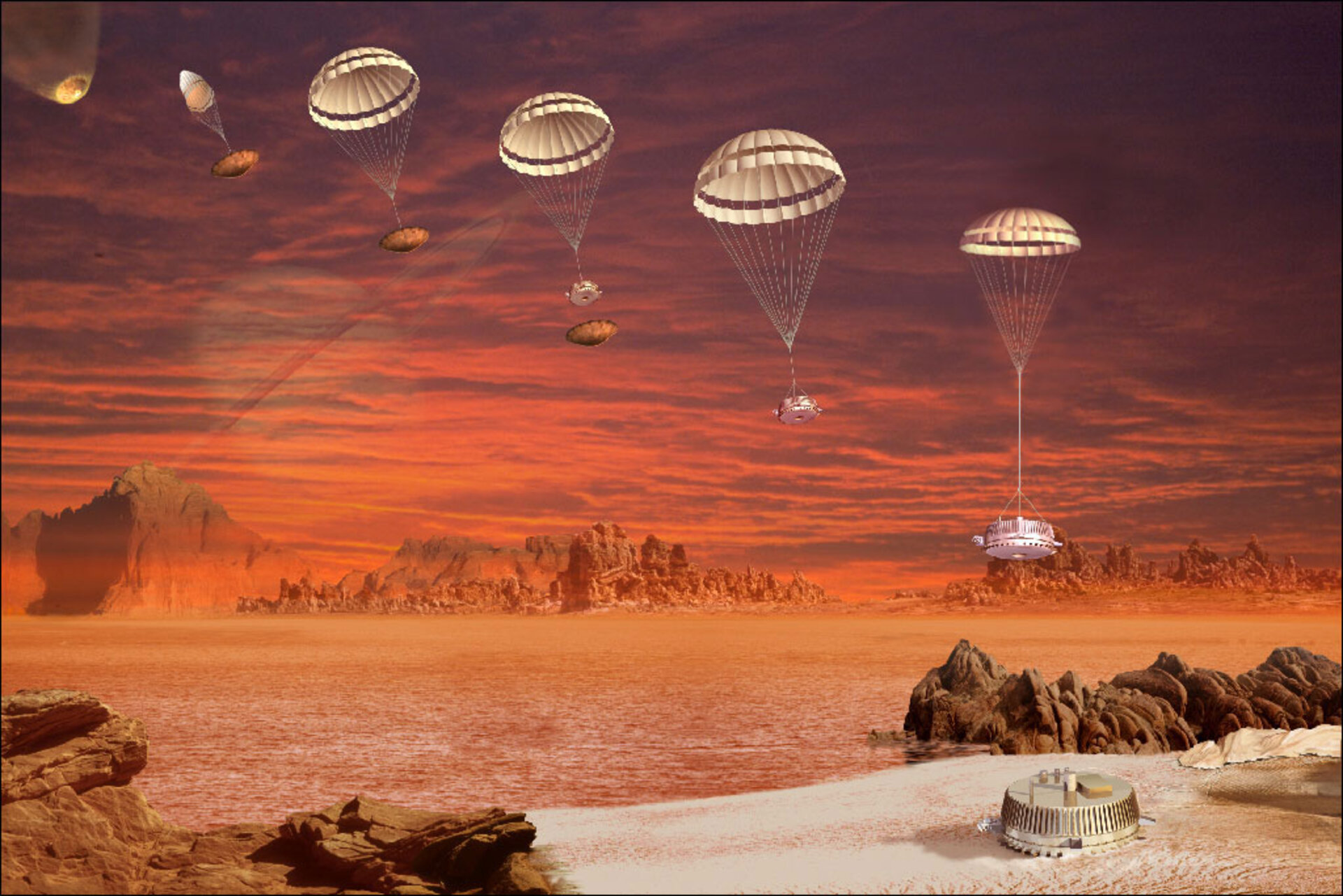
the Huygens probe, which parachuted through Titan’s orange haze in 2005 and touched down more than a billion kilometres from Earth in cold that dropped below minus 170 degrees Celsius
The European Huygens probe remains the only spacecraft to land in the outer solar system, touching down on Saturn’s moon Titan in January 2005. According to mission data, it revealed a methane-based hydrological cycle. NASA’s upcoming Dragonfly mission aims to expand this research by deploying a mobile rotorcraft in the 2030s.
Why is Titan the primary target for future outer solar system landings?
Titan is the only moon in the solar system with a thick atmosphere. This dense shroud of nitrogen and methane creates a “cold mirror” of Earth, according to mission records from the European Space Agency (ESA) and NASA.
The moon’s surface features stable bodies of liquid, which is a rarity beyond Earth. While our world relies on water, Titan uses methane. It evaporates, forms clouds, and falls as rain to carve rivers and fill seas at temperatures around minus 180 degrees Celsius.
This organic chemistry makes Titan a high-priority target for astrobiologists. The presence of liquid and complex organics suggests conditions that could potentially support prebiotic chemistry or unconventional forms of life.
How will the Dragonfly mission differ from the Huygens probe?
The Huygens probe was a stationary lander. It descended via parachutes, transmitted data for 72 minutes, and then fell silent. It provided a “snapshot” of a single location: a damp, dark plain of water-ice pebbles.
NASA’s Dragonfly mission shifts the strategy from stationary observation to mobility. Dragonfly is a nuclear-powered rotorcraft designed to fly between different sites across Titan’s surface. It’s scheduled to launch later this decade and arrive in the 2030s.
Comparative Mission Capabilities
| Feature | Huygens (2005) | Dragonfly (2030s) |
|---|---|---|
| Mobility | Stationary | Multi-site Flight |
| Power Source | Battery/Limited | Nuclear-powered |
| Primary Goal | First Landing/Atmospheric Profile | Chemical Diversity/Habitability |
What does the methane cycle reveal about planetary evolution?
The discovery of branching channels and shorelines on Titan proves that liquid flow can shape a world even without water. According to ESA data, the “river cobbles” found by Huygens are actually rounded lumps of water ice, hardened by the extreme cold.
This suggests that “weather” and erosion aren’t exclusive to Earth-like temperatures. It expands the definition of a “working world.” If a moon at minus 180 degrees Celsius can have a functioning hydrological cycle, the search for habitable zones in the galaxy must broaden.
Scientists now look at Titan as a laboratory for the early Earth. The thick organic smog may mimic the conditions present before life began on our own planet, providing a glimpse into the chemistry of origin.
Frequently Asked Questions
What is the farthest landing ever made?
The European Huygens probe is the most distant landing, touching down on Titan, more than a billion kilometers from Earth.
Can humans land on Titan?
Not currently. Surface temperatures are roughly minus 180 degrees Celsius, and the atmosphere is 1.5 times denser than Earth’s sea-level pressure.
What is Dragonfly?
Dragonfly is a NASA mission featuring a nuclear-powered drone that will fly across Titan’s surface in the 2030s to study its chemistry.
Want to stay updated on the search for alien life? Subscribe to our space exploration newsletter or leave a comment below telling us if you think we’ll find life on Titan.