
Underground detector unveils first major findings about mysterious ghost particles
The Jiangmen Underground Neutrino Observatory (JUNO) in China released its first major results on Wednesday in the journal Nature. The findings, based on two months of data collection starting in August, offer some of the most precise measurements to date of how neutrinos switch between three “flavors” while traveling through space.
How does the JUNO detector work?
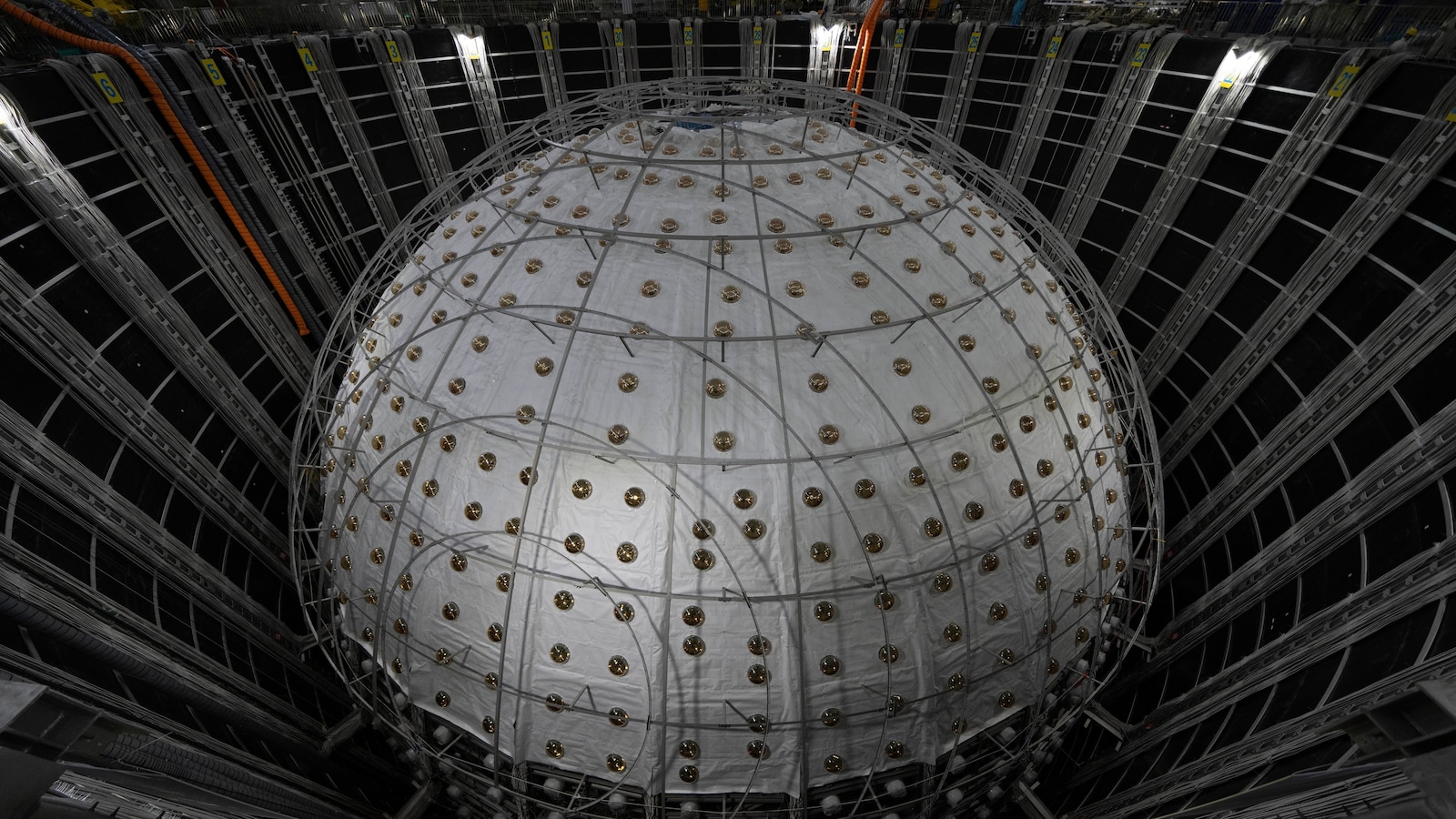
The spherical JUNO detector operates 2,297 feet (700 meters) underground. It monitors antineutrinos, which are opposite versions of neutrinos, generated by collisions inside two nearby nuclear power plants.

According to the study, a flash of light is produced when these antineutrinos encounter particles within the detector. This process allows scientists to study neutrino behavior and characteristics.
Why do these neutrino measurements matter?
Researchers are using the detector to resolve a mystery regarding the mass of each neutrino flavor. Current theories suggest two flavors have similar weights while a third is an “oddball,” though it isn’t yet clear if the oddball is the lightest or heaviest of the three.
Study co-author Liangjian Wen, a member of the JUNO collaboration, said the initial results demonstrate the detector’s capabilities. Wen stated the facility “will be able to test the finer ripples” that separate neutrino masses and flavors.
What happens next for global neutrino research?
The JUNO results may be cross-checked by other international projects. Japan’s Hyper-Kamiokande and the Deep Underground Neutrino Experiment in the United States are both set to begin data collection within the next decade.
These facilities could use different research approaches to verify the data coming out of the Chinese observatory. Physicist Kate Scholberg of Duke University, who was not involved in the research, said the initial results make her “look forward to more exciting results in the future.”
Frequently Asked Questions
What is the primary goal of the JUNO detector?
The goal is to understand neutrinos, specifically how they switch between flavors and the specific mass of each variety.
Where is the JUNO facility located?
The detector is located 2,297 feet (700 meters) underground in China.
Which other countries are developing similar detectors?
Japan is developing the Hyper-Kamiokande, and the United States is developing the Deep Underground Neutrino Experiment.
How could the discovery of neutrino mass change our understanding of the Big Bang?