
Violent rocket particles could reshape future spacecraft design
Beyond the Sphere: How Nanoparticle Dynamics Are Redefining Hypersonic Flight
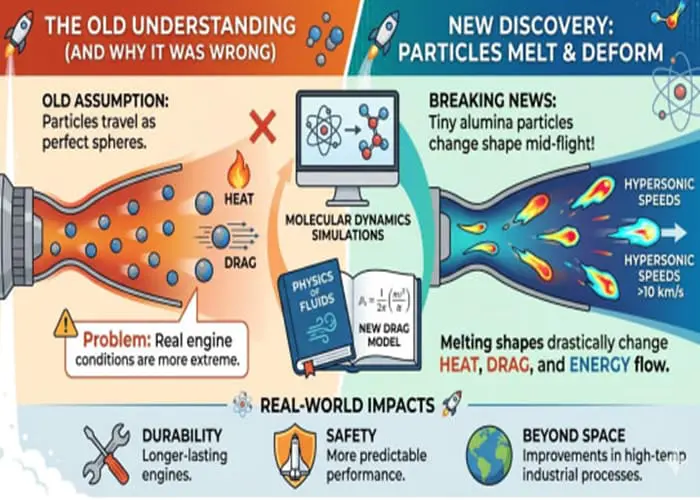
For decades, aerospace engineers have operated under a comfortable assumption: that the microscopic particles fueling our rockets behave like tiny, perfect spheres. It was a simplification that made the math manageable and the simulations predictable. However, groundbreaking research from Monash University has just shattered that illusion, revealing that at hypersonic speeds, these particles melt, stretch, and deform into “bag-like” structures.
This isn’t just a curiosity of fluid dynamics; it is a fundamental shift in how we understand energy transfer in extreme environments. When particles traveling at 10 kilometers per second change shape, they change the very nature of drag and heat flux. As we push toward deeper space exploration and more agile defense systems, the industry is moving toward a new era of “dynamic modelling” where the unpredictable becomes the baseline.
The Death of the ‘Spherical Assumption’ in Propulsion Design
The reliance on spherical models in Computational Fluid Dynamics (CFD) has created a “precision gap.” By assuming particles remain rigid, engineers may have been underestimating the wear and tear on rocket nozzles and miscalculating the efficiency of fuel combustion. The Monash study, published in Physics of Fluids, proves that the surface-area-to-volume ratio of these particles causes them to heat up and deform rapidly.
The future trend here is the integration of Molecular Dynamics (MD) simulations into standard engineering workflows. Instead of treating a flow of particles as a uniform gas, next-generation propulsion software will track atom-by-atom interactions. This allows designers to predict exactly where “hot spots” will develop inside a motor, leading to the development of nozzles that can withstand asymmetric thermal loads.
Impact on Solid Rocket Motor (SRM) Efficiency
When a particle flattens or stretches, its drag coefficient changes. In the world of hypersonic propulsion, even a fractional change in drag can lead to significant losses in thrust or unexpected turbulence. We are likely to see a trend toward “fuel tailoring,” where the chemical composition of alumina fuel is adjusted to control the melting point and deformation characteristics of the resulting nanoparticles.
From Rockets to Re-entry: The Broader Hypersonic Frontier
While the research focused on rocket motors, the implications stretch far beyond the launchpad. Any vehicle entering an atmosphere at hypersonic speeds—whether it’s a SpaceX Starship or a defense glide vehicle—deals with a plasma sheath and microscopic debris that behave similarly to the particles studied by Monash.
The ability to model how nanoparticles deform in high-pressure air is critical for improving Thermal Protection Systems (TPS). Current heat shields are designed for a specific type of thermal flux. If we now know that particles are “stretching” and transferring heat differently, we can develop bio-mimetic or graded materials that dissipate heat more effectively, reducing the weight of the shield and increasing payload capacity.
Industrial Spinoffs: Energy and Nano-Manufacturing
The “Monash Effect” isn’t limited to aerospace. The behavior of nanoparticles in extreme heat is a cornerstone of several emerging industrial trends:
- Advanced Plasma Spraying: Used to create wear-resistant coatings on turbine blades. Understanding particle deformation allows for denser, more durable coatings.
- High-Temperature Energy Systems: Future fusion reactors and concentrated solar power plants deal with similar high-pressure, high-temperature fluid dynamics.
- Nanoparticle Synthesis: By controlling the “collapse” of molten particles, manufacturers can create specific nanoparticle shapes for medical and electronic applications.
For more on how these materials are evolving, explore our deep dive into the future of high-temperature alloys (Internal Link).
Frequently Asked Questions
Why does the shape of a nanoparticle matter?
Shape dictates drag and heat transfer. A sphere has the minimum surface area for its volume; a deformed, “stretched” particle has more surface area, which increases its interaction with the surrounding air and changes how it absorbs and releases heat.
What are alumina nanoparticles?
These are microscopic particles of aluminum oxide formed when aluminum fuel burns in a solid rocket motor. They are a byproduct of the combustion process but significantly influence the engine’s internal environment.
How does this research affect future spacecraft?
It allows for more accurate predictions of engine wear and heat distribution. This leads to safer, more efficient engines and better heat shields for vehicles returning from space.
Join the Conversation
Do you think the industry has been too reliant on simplified models, or is the “spherical assumption” still a practical necessity for most designs? We want to hear from the engineers and space enthusiasts in our community.
Leave a comment below or subscribe to our newsletter for the latest insights into aerospace innovation!