

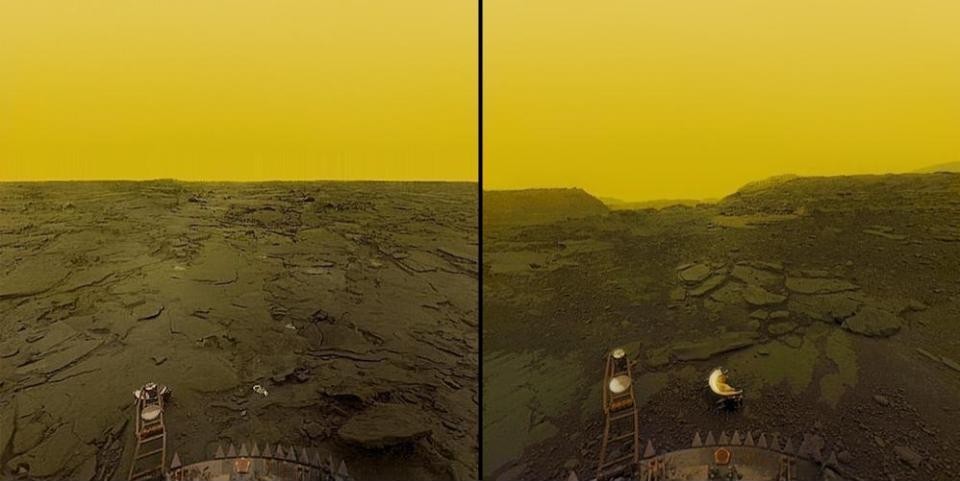
When the Soviet Venera 13 probe touched down on Venus in March 1982, it survived for 127 minutes in a 465-degree atmosphere that crushed it with the pressure of nearly a kilometre of ocean water, and in that time it scraped a soil sample, analysed it, and transmitted the first colour photographs ever taken from the surface of another planet.
Venus remains the most hostile environment in the solar system, yet future space exploration is shifting from orbital observation back to surface-level contact. While the Soviet Union’s Venera 13 probe established the record for surface survival at 127 minutes in 1982, modern engineering at NASA and the European Space Agency is now focusing on durable, heat-resistant electronics to survive the 465-degree Celsius conditions that previously limited mission lifespans.
How can modern electronics survive the Venusian surface?
Future missions are moving away from the “thermos flask” approach used by the Soviet Lavochkin design bureau. According to NASA’s Glenn Research Center, the key lies in silicon-carbide semiconductors. Unlike traditional silicon-based electronics that fail at 250 degrees Celsius, these new materials can function at 500 degrees Celsius without bulky cooling systems. While Venera 13 relied on pre-chilled compartments and thermal insulation that eventually succumbed to the heat, future landers may operate indefinitely by utilizing circuitry that is inherently heat-tolerant.
The pressure at the Venusian surface is roughly 9.2 megapascals, which is equivalent to standing under 900 metres of seawater. This is why Soviet engineers designed the Venera landers more like deep-sea bathyspheres than traditional spacecraft.
Why is the focus shifting to descent-phase science?
While the goal of landing remains, agencies are prioritizing the atmosphere. NASA’s upcoming DAVINCI mission, scheduled for the early 2030s, focuses on the descent phase rather than long-term surface operations. According to mission parameters, this allows researchers to map the chemical composition of the atmosphere, which holds heat like an “iron skillet,” as described by planetary scientists. This contrasts with the 1980s-era strategy of the Venera program, which prioritized immediate surface contact despite the high probability of rapid mechanical failure.
What lessons from the Venera program guide current missions?
The Venera lineage provides a blueprint for managing hardware failure in extreme environments. As documented by Tech Times, the primary hurdle for early missions was the “lens-cap problem,” where mechanical release failures prevented cameras from functioning. By the time Venera 13 launched, engineers had implemented redundant pyrotechnic systems. Modern mission planners now use this history to emphasize the importance of mechanical simplicity. Even with 40 years of progress, no current mission has officially announced plans to exceed the 127-minute survival record set by Venera 13, highlighting the enduring difficulty of the Venusian environment.
Pro Tips for Understanding Venusian Exploration
- Look for the source: Distinguish between raw, low-resolution scans from the 1980s and modern, high-resolution colorized interpretations that often circulate on social media.
- Check the altitude: Surface temperature on Venus varies by elevation; landers that touch down in elevated regions like Phoebe Regio gain a slight thermal advantage.
- Follow the chemistry: The basaltic composition confirmed by Venera 13’s X-ray fluorescence spectrometer remains the primary geological data point for current mission modeling.
Frequently Asked Questions
Will we ever send a permanent base to the surface of Venus?
Currently, no. The combination of 465-degree heat and 92 atmospheres of pressure makes long-term habitation or robotic base stations impossible with existing material science.
Are the rocks on Venus similar to those on Earth?
Yes. According to chemical analysis from Venera 13, the surface composition is consistent with alkaline basalts found in terrestrial rift zones.
What happened to the Venera 13 lander?
The probe remains on the surface of Venus. Scientists estimate that the titanium pressure vessel could remain structurally recognizable for thousands of years due to the slow rate of sulphuric acid corrosion.
What do you think is the next frontier for Venusian exploration? Share your thoughts in the comments below or subscribe to our newsletter for more deep dives into the history of planetary science.