

with tin jingles and reclaimed blankets, marie watt revisits ancestral craft
Artist Marie Watt, a member of the Turtle Clan of the Seneca Nation of Indians, creates immersive installations that bridge the gap between historical craft and contemporary storytelling. By utilizing reclaimed wool blankets, tin jingles, and collaborative sewing circles, the Seattle-born artist transforms everyday materials into “living archives” that document human connection and indigenous heritage.
How Marie Watt uses textiles to preserve memory
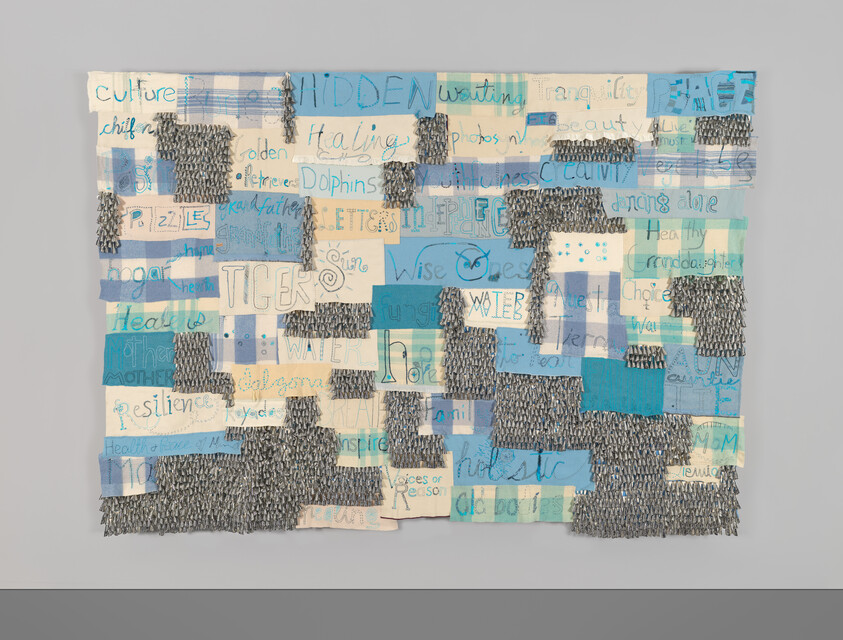
Watt’s work centers on the “living archive” quality of reclaimed blankets. These materials, which bear the marks of previous use, are repurposed in pieces like 2025’s Long Night Eclipsed (Winter Solstice) and Solstice. By combining wool with satin bindings and embroidery, Watt gives these used items a structured voice, ensuring that the history of their previous lives remains intact within a new artistic context.

Did You Know? The tin jingles featured in Watt’s installations are rooted in the Ojibwe Jingle Dress Dance, a tradition that emerged in the early 1900s during the influenza pandemic and persisted despite historical bans on ceremonial gatherings in the United States.
Why collaboration is at the center of the work
The artist’s practice relies on sewing and printing circles that function as both a process and a social form. In projects like 2023’s Singing Everything: Crescendo (Staccato), developed with the Whitney Museum of American Art, Watt invited communities to answer the question, “What do you want to sing a song for in this moment?” The resulting work incorporated over one hundred panels and the efforts of more than 300 participants, effectively turning individual handwriting and voices into a collective textile field.
Expert Insight: The significance of Watt’s collaborative approach lies in her ability to treat craft as a form of social relation. By moving beyond purely visual art, she forces the viewer to engage with the work through sound and touch, creating a tangible connection between the individual participant and the broader historical narrative of the community.
How steel and sound expand the reach of craft
Watt’s recent sculptures, such as 2023’s Skywalker/Skyscraper (Quiver), integrate industrial materials like steel I-beams with traditional textiles. This 108-inch-high piece references the history of Indigenous ironworkers, grounding the softness of wool in the reality of urban infrastructure. Similarly, installations like Sky Dances Light utilize tin jingles that sound when air moves through them, requiring viewers to “listen with the body” to understand the history of adornment and healing embedded in the metal.
What may happen next for these installations
As Watt continues to explore the intersection of community, storytelling, and material memory, her future work may further integrate these “companion species” of textiles and industrial forms. Because her process relies on the expansion and contraction of sewing circles, it is likely that future exhibitions will continue to prioritize site-specific community engagement. Observers might expect to see a continued evolution in how she balances the structural weight of urban materials with the intimacy of hand-stitched memories, potentially scaling these projects to further examine the relationship between the built environment and Indigenous teachings.
Frequently Asked Questions
What materials does Marie Watt primarily use in her art?
Watt works with a variety of materials, including reclaimed wool blankets, satin bindings, embroidery floss, thread, canvas, cotton twill tape, tin jingles, and steel I-beams.
What is the significance of the tin jingles in her work?
The jingles are connected to the Ojibwe Jingle Dress Dance, a tradition of healing and adornment. They allow the artwork to move beyond the visual, creating a “soft metallic murmur” that invites the viewer to listen with their body.
How do community participants contribute to Watt’s projects?
Participants engage in sewing and printing circles where they share stories and respond to prompts by hand. These individual contributions are then translated into large-scale textile works, such as the 100-panel Singing Everything: Crescendo (Staccato).
How does the act of stitching together a story change the way we perceive the history of an object?