
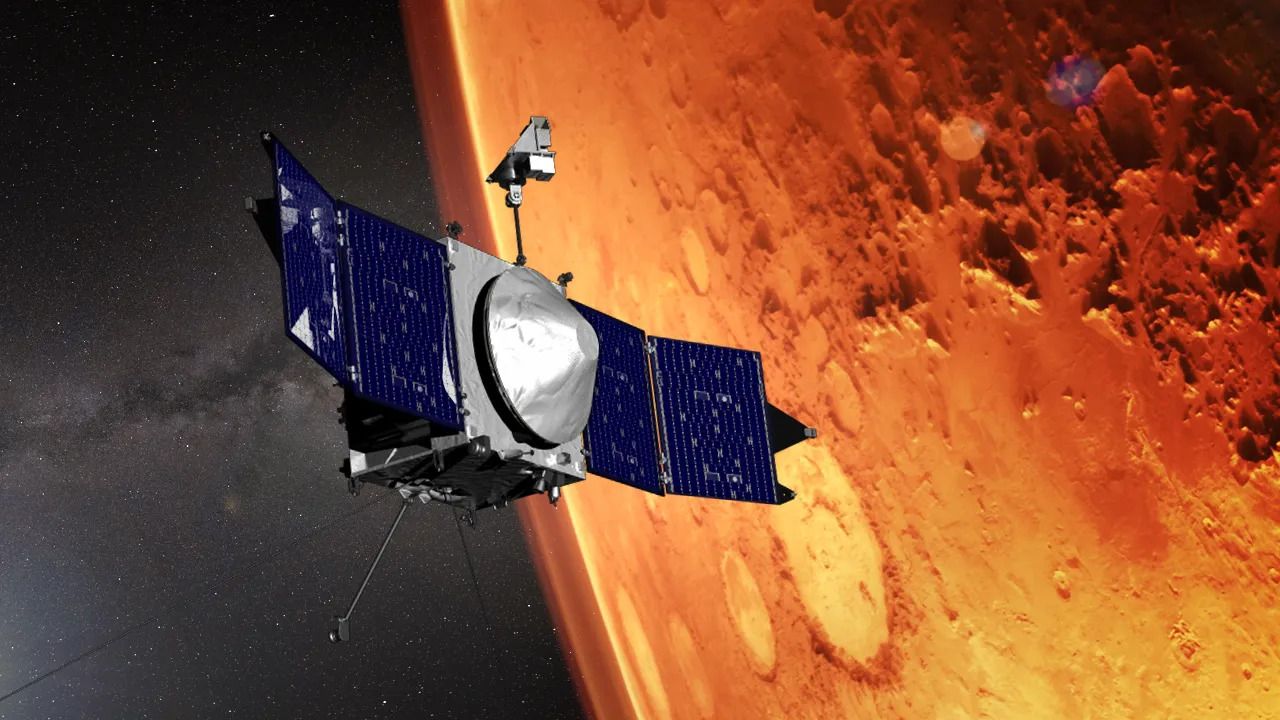
Best. Mars. Mission. Ever.’ Scientists hail MAVEN’s legacy as NASA retires Red Planet orbiter
NASA has officially decommissioned the MAVEN orbiter following an 11-year mission that fundamentally altered scientific understanding of the Martian atmosphere. According to Mike Moreau, project manager at NASA’s Goddard Space Flight Center, the spacecraft is officially unrecoverable after losing contact in December 2025. Investigations suggest an unexplained anomaly forced the probe into a spinning “safe mode,” which exhausted its battery reserves and disabled its communications systems.
How MAVEN Transformed Mars Science
MAVEN, which stands for Mars Atmosphere and Volatile Evolution, arrived at the Red Planet in 2014 to solve a long-standing mystery: how a once-wet, habitable world became a cold, barren desert. According to the mission’s principal investigator, Shannon Curry of the University of Colorado Boulder, the orbiter provided the most comprehensive data on atmospheric escape ever collected at any planet, including Earth. Over its tenure, the spacecraft contributed to more than 800 scientific publications, documenting how solar storms strip away atmospheric gases and how global dust storms accelerate the loss of surface water.
MAVEN was not just a science probe; it served as a high-capacity data relay. Despite handling only 8% of all relay sessions during its life, it transmitted nearly 18% of all science data collected from the Martian surface.
What Happens to the Mars Relay Network?
The loss of MAVEN creates a capacity gap, but NASA officials describe the current network as resilient. Tiffany Morgan, director of NASA’s Mars Exploration Program, stated that while the agency expects slight delays in data return, the remaining fleet—including Mars Odyssey, the Mars Reconnaissance Orbiter, Mars Express, and the European Space Agency’s Trace Gas Orbiter—will absorb the workload. To address the long-term void, NASA is actively exploring the integration of a commercial telecommunications network to support future surface missions.

Future Trends in Martian Exploration
The decommissioning of MAVEN signals a shift toward more specialized, multi-spacecraft operations. While MAVEN was a standalone atmospheric specialist, the future favors “constellation” approaches, such as the recently launched ESCAPADE mission. These dual-spacecraft missions are designed to provide simultaneous, multi-point measurements of the Martian magnetosphere. Relying on multiple smaller satellites reduces the risk profile for NASA; if one unit fails, the mission objective remains viable through its partner craft—a clear departure from the “all-in-one” orbiter strategy of the previous decade.
Keep an eye on upcoming NASA solicitations for commercial “relay-as-a-service” contracts. Industry experts expect private satellite operators to play a larger role in deep-space communications by 2030.
Frequently Asked Questions
Will MAVEN crash into Mars?
Not immediately. According to NASA, the spacecraft will remain in orbit for another 50 to 100 years. Eventually, atmospheric drag will pull the orbiter into the planet, where it will incinerate upon entry.
Can we still see the MAVEN spacecraft?
Mission scientists are considering using cameras on current Mars rovers to attempt a final image of the silent orbiter. However, previous attempts to spot inactive spacecraft from the surface have been unsuccessful, according to project reports.
Why did the spacecraft start spinning?
The exact cause remains under investigation. A NASA review board confirmed the craft was operating normally until it passed behind Mars. Telemetry suggests it emerged in a spinning state, which investigators believe drained the batteries.
What do you think is the biggest legacy of the MAVEN mission? Share your thoughts in the comments below or subscribe to our newsletter for the latest updates on Mars exploration.