
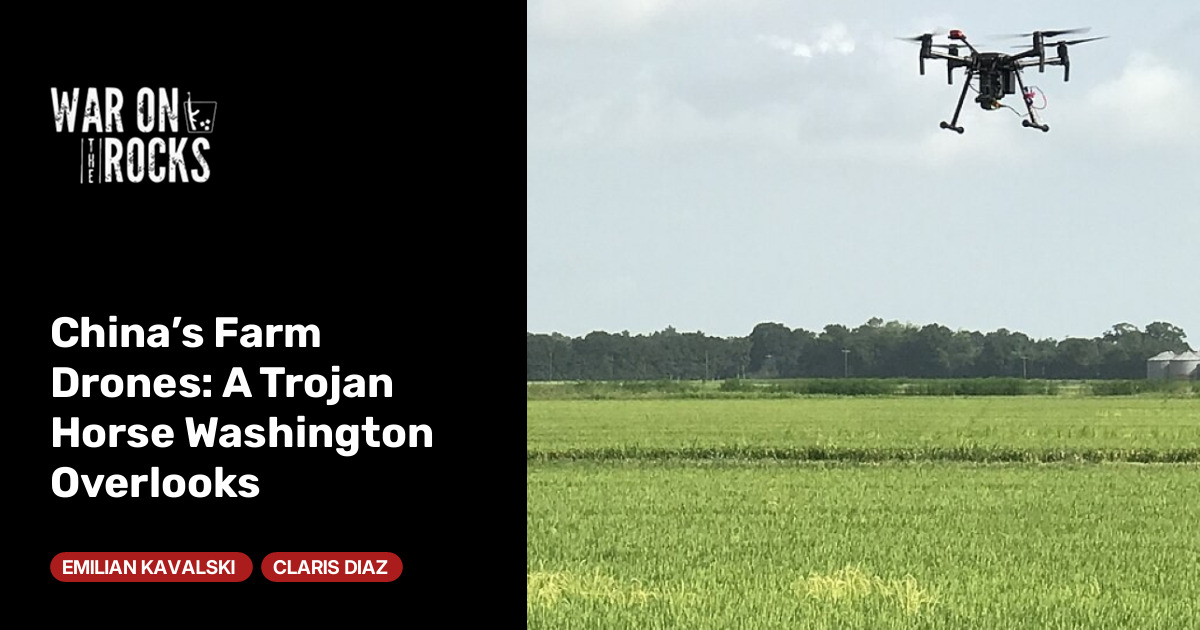
Chinese Farm Drones: An Overlooked National Security Threat
Chinese agricultural drones pose a greater national security risk to the United States than social media platforms like TikTok, according to analysts Emilian Kavalski and Claris Diaz. Writing for War on the Rocks, the authors argue that while Washington fixates on consumer data from TikTok, it overlooks the strategic vulnerability of integrating foreign technology into critical food production systems.
Why are agricultural drones more risky than TikTok?
Agricultural drones provide access to operational data on critical infrastructure, whereas TikTok primarily collects consumer behavioral data. Kavalski and Diaz argue in their analysis, “Beyond TikTok – The National Security Risks of Chinese Agricultural Drones,” that the debate over social media is too narrow. This focus creates a blind spot for technologies embedded in the U.S. food supply chain.
Drones used for crop spraying and field mapping collect high-resolution data on soil health, crop yields, and land use. According to the authors, this information allows a foreign power to monitor food security and identify systemic vulnerabilities in the American agricultural sector. Unlike a social media app, these drones operate directly on the land that sustains the national population.
How does “Trojan Horse” technology affect food security?
The “Trojan Horse” risk refers to technology that enters a market as a helpful tool but contains hidden capabilities for surveillance or disruption. Kavalski and Diaz suggest that by the time Washington recognizes the risk of agricultural drones, the technology may already be too deeply integrated into farming operations to remove without causing economic shock.
This creates a strategic imbalance. While the U.S. government pursues TikTok ban cycles, foreign entities may gain a comprehensive understanding of U.S. agricultural output. This data is critical for predicting economic stability and identifying leverage points during geopolitical tensions.
Comparing the Risks: TikTok vs. Ag-Drones
The difference in risk profiles is a matter of scale and impact. Based on the arguments presented by Kavalski and Diaz, the risks break down as follows:
- TikTok: Focuses on user preferences, psychological profiling, and individual data harvesting.
- Agricultural Drones: Focuses on national resource mapping, food supply vulnerabilities, and critical infrastructure data.
What happens if the U.S. continues to prioritize social media bans?
Prioritizing social media over critical infrastructure risks leaving the “back door” open. Kavalski and Diaz argue that the current national security discourse is distracted. If policymakers ignore the hardware side of foreign technology, they miss the chance to secure the physical systems that ensure national survival.
The consequence is a fragmented security strategy. The U.S. may successfully restrict a communication app while remaining dependent on foreign-made hardware for its food supply. This creates a paradox where the government secures the “digital town square” but leaves the “national granary” exposed.
Frequently Asked Questions
Are all agricultural drones a security risk?
The risk specifically concerns drones manufactured by foreign adversaries that may have data-sharing requirements with their home governments, as highlighted by Kavalski and Diaz.

Why is crop data considered a national security issue?
Crop yields and soil data can be used to predict food shortages or economic instability, providing a foreign power with strategic intelligence to use in trade wars or diplomatic disputes.
Has the U.S. government acted on these drone risks?
While there is significant focus on TikTok, the authors of the War on the Rocks piece argue that the response to agricultural drone risks has been insufficient compared to the scale of the threat.
What do you think? Is the focus on TikTok a distraction from more serious hardware threats? Share your thoughts in the comments below or subscribe to our newsletter for more deep dives into national security.