
Effect of changing kick frequency on inter-joint coordination during undulatory underwater swimming
Competitive swimmers hitting a performance plateau during undulatory underwater swimming (UUS) may be limited by their own kick frequency, according to a recent study using three-dimensional motion analysis. Researchers found that while increasing kick frequency boosts velocity, the benefit stalls once swimmers exceed their optimal frequency. This occurs because faster kicking forces a trade-off that impairs essential trunk movement, despite the swimmer’s attempt to maintain consistent hip-knee reversal times.
Why Velocity Plateaus at High Frequencies
Swimming velocity increases alongside kick frequency until it hits a ceiling at 100% of a swimmer’s optimal rate. Data indicates that when swimmers push to 110% or 120% of that optimal frequency, their body mechanics shift in a way that prevents further speed gains.
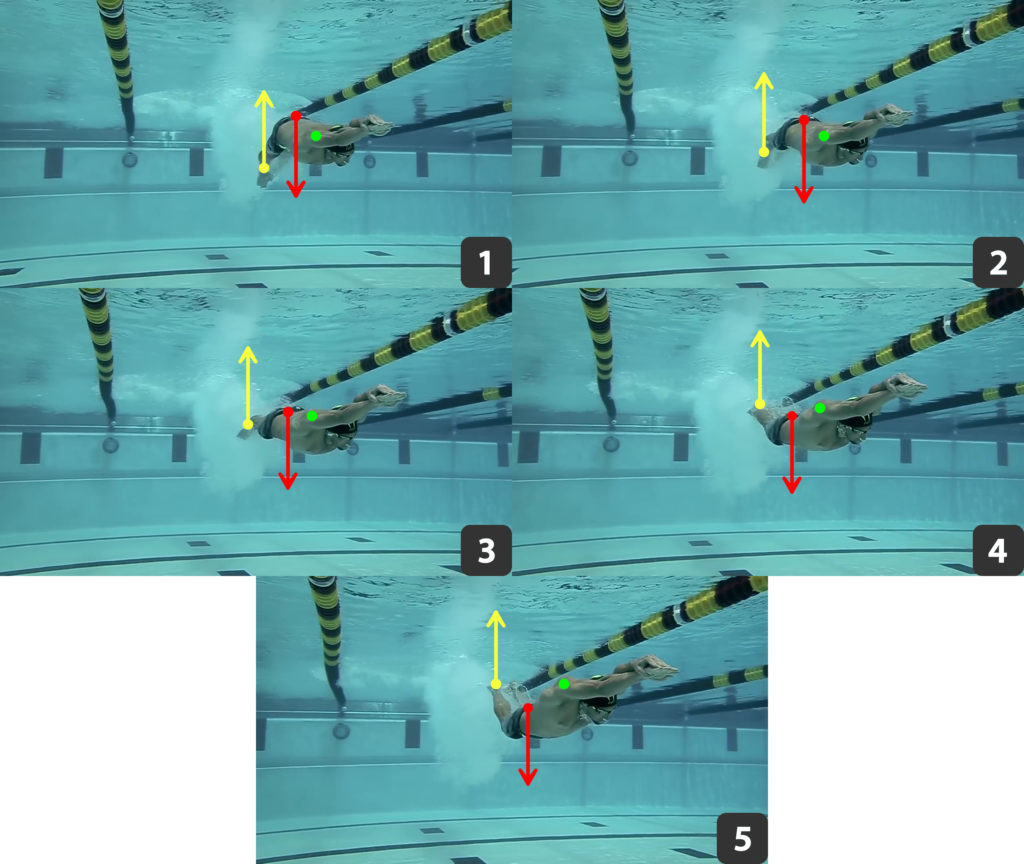
The primary issue involves the hip-knee anti-phase pattern, where the joints rotate in opposite directions with greater angular displacement at the knee. While swimmers effectively maintain the duration of this reversal phase regardless of how fast they kick, they cannot sustain the necessary trunk undulation during the late downward kick. This constraint on the trunk appears to be the mechanical factor responsible for the velocity plateau.
What Happens Next
Future training protocols for competitive swimmers could focus on finding an athlete’s specific optimal kick frequency rather than simply encouraging faster leg movement. Because the study suggests that pushing beyond the optimal frequency leads to impaired trunk undulation, trainers may look to emphasize coordination and fluidity over raw speed to maximize efficiency in the water.

Frequently Asked Questions
Does increasing kick frequency always lead to higher velocity?
No. While velocity increases with kick frequency, the study found that this performance gain plateaus once swimmers move beyond 100% of their optimal kick frequency.
What happens to the body at very high kick frequencies?
At 110% and 120% of optimal frequency, the time required for hip-knee reversal is maintained, but trunk undulation during the late downward kick becomes constrained, which likely limits swimming speed.
How was the swimmers’ movement analyzed?
The study used three-dimensional underwater motion analysis and the Modified Vector Coding Technique to examine the coordination between the trunk–hip and hip–knee joints.
How might these findings change the way coaches approach underwater training for competitive athletes?