
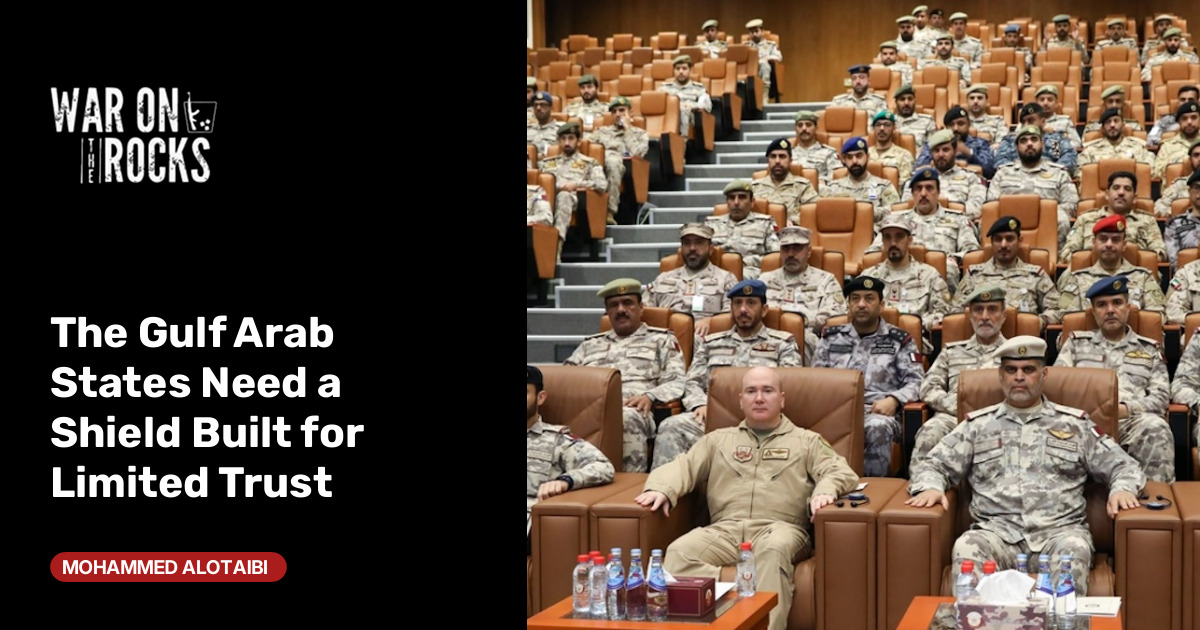
Engineering a Limited-Trust Defense Shield for the Gulf
The Gulf’s Defense Dilemma: Why Integration Remains Elusive
Despite decades of institutional building, the Gulf Cooperation Council (GCC) struggles to create a unified defense architecture, according to a 2025 analysis by the Regional Security and Defense Institute. Missiles, drones, and maritime disruptions transcend borders, yet national permissions often delay collective action. The 2025 Doha attack exposed this gap, with Gulf states calling for intelligence-sharing and early warning systems—measures already outlined in 2000 agreements but never institutionalized into routine operations.
“The region has advanced sensors and interceptors, but these remain fragmented,” said Mohammed Alotaibi, a policy practitioner with 20 years of experience in Gulf security. “A shared shield must function in an environment of limited trust, not political harmony.”
Why Gulf Defense Integration Keeps Failing
The GCC’s defense framework has long been a work in progress. The 2000 Joint Defense Agreement and 2013 Unified Military Command were steps forward, but repeated crises—from the 2023 Red Sea disruptions to the 2026 Strait of Hormuz crisis—reveal a pattern: “Integration is always reactive, not proactive,” Alotaibi noted.

Internal disputes, such as the 2017 GCC rupture and ongoing Qatar-Saudi tensions, create a “central design constraint,” according to the Foreign Policy Research Institute. Smaller states fear subordination, while larger ones worry about losing autonomy. “The U.S. role compounds this,” Alotaibi said. “Bilateral ties with Washington offer quick interoperability, but they leave the region fragmented at the tactical level.”
For example, during the 2023 Red Sea crisis, Bahrain aligned with U.S.-led naval efforts, while Saudi Arabia adopted a cautious stance. Oman mediated, and the UAE pursued a selective posture. “These choices were rational, but the GCC lacked a mechanism to turn national postures into coordinated action,” Alotaibi explained.
Disconnected Shields in a Connected Threat Space
The Gulf’s defense architecture faces a paradox: economic diversity is a strength, but security requires pooling. Missiles and cyberattacks ignore borders, yet national systems operate in silos. After the 2026 Strait of Hormuz disruption, war risk premiums for shipping surged, signaling a regional security “exposure system,” according to analysts.
“A state can’t separate its energy exports from Gulf security geography,” said Alotaibi. The UAE’s 2026 decision to leave OPEC highlights this: Abu Dhabi seeks production autonomy, but its energy infrastructure remains entangled with regional maritime routes and insurance markets.
“The solution is a differentiated model of sovereignty,” Alotaibi argued. “Economic competition is fine, but external security functions need operational pooling.”
Engineering a Regional Operating System
A limited-trust defense shield requires phased integration. The first step: institutionalizing low-latency data fusion. Gulf states should create a “federated warning network” for radar tracks and maritime alerts, as outlined in a 2025 report by the Center for Strategic and International Studies.

“This starts with shared data, not command structures,” Alotaibi said. For example, a missile detected in Saudi Arabia could trigger an alert in the UAE, allowing the best-positioned interceptor to respond. “The key is pre-negotiated authority protocols—defining what happens automatically and what requires national approval.”
A standing maritime security task force, focused on the Red Sea and Hormuz, is another priority. “This isn’t a symbolic committee—it’s a practical operating cell with a budget and reporting chain,” Alotaibi said. The U.S.-led Operation Prosperity Guardian shows the need for such a body, but it must be Gulf-owned.
Missile Math and the Cost of Saturation
The 2025 Doha attack highlighted the Gulf’s vulnerability to saturation attacks. A 2025 study by the Foreign Policy Research Institute found that 5,197 munitions were expended in 96 hours during Operation Epic Fury. “Low-cost drones exhaust high-cost interceptors faster than industries can replenish them,” Alotaibi noted.
This creates a “reload dilemma”: If each Gulf state hoards interceptors, the region runs out faster. “The answer is shared warning systems and tiered defense layers,” Alotaibi said. “A drone threat could be handled by low-cost counter-drone systems, reserving interceptors for critical assets.”
However, interoperability gaps persist. U.S.-made systems dominate, but diversity in sensors and shooters complicates integration. “Advanced systems don’t automatically create a shield,” Alotaibi said. “They need shared data standards and command protocols.”
Frequently Asked Questions
What is the main challenge to Gulf defense integration?
The GCC’s defense architecture struggles with political distrust and fragmented national interests. Smaller states fear subordination, while larger ones prioritize autonomy, according to a 2025 analysis by the Regional Security and Defense Institute.
How does the U.S. impact Gulf security?
The U.S. remains a critical partner, providing technology and interoperability. However, reliance on Washington as an “operational switchboard” risks delays during crises, as Gulf states often prioritize bilateral ties over regional coordination.
What is a “limited-trust shield”?
A defense system designed to function despite political competition. It includes modular, auditable, and bounded mechanisms that allow states to share data and respond to threats without requiring full political harmony.
Did You Know?
The 2017 GCC rupture demonstrated that shared exposure doesn’t erase competing strategies. Gulf states will continue to hedge, compete, and maneuver differently, even as threats operate as a single system.
Pro Tip
Focus on data-sharing first. A federated warning network can improve situational awareness without requiring immediate command integration. This builds trust incrementally, addressing the “governance problem” of slow political decision-making.
Learn more about the UN University Institute’s research on regional integration.