
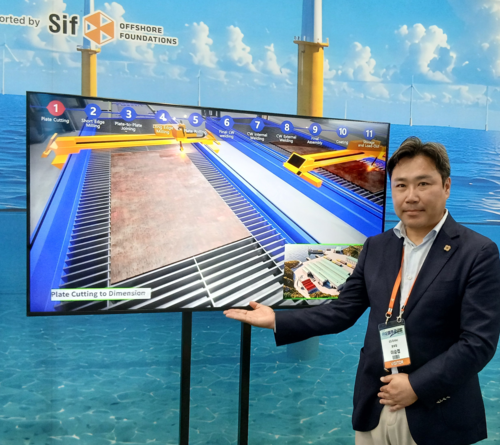
GS Entec Boosts Offshore Wind Competitiveness with Automated Monopile Production Plant
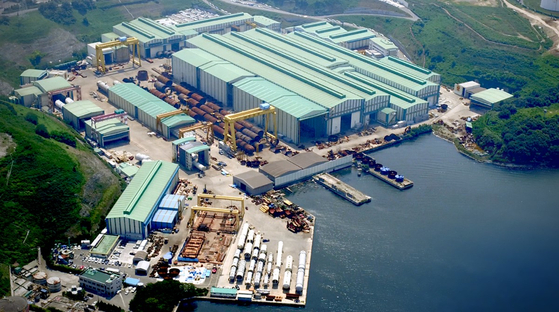
GS엔텍 is investing 300 billion KRW to establish a fully automated production line for offshore wind monopiles at its Ulsan Yongjam plant, aiming to mirror the advanced manufacturing capabilities of Dutch leader Sif. According to Lee Seung-yeop, GS엔텍’s Sales Division Head, the facility will be the only one in South Korea capable of complete monopile process automation, significantly boosting the country’s offshore wind supply chain competitiveness.
How Does Monopile Automation Change Offshore Wind Economics?
Monopiles serve as the primary foundation for offshore wind turbines, acting as the structural “roots” that anchor massive turbines to the seabed. According to Lee Seung-yeop, automating the production process is essential for scaling the industry because foundations account for a significant portion of total installation costs. By adopting the technical standards of global leader Sif, GS엔텍 aims to produce these large-scale steel structures more reliably and efficiently.
Why Are Monopiles Preferred Over Jacket Foundations?
Monopile foundations are becoming the industry standard due to their cost-efficiency compared to jacket structures. Lee Seung-yeop notes that over 80% of European offshore wind projects currently utilize monopile designs. The primary advantages include lower steel consumption and shorter installation timelines, which directly reduce the overall capital expenditure of wind farm developments.
| Feature | Monopile | Jacket Structure |
|---|---|---|
| Steel Usage | Lower | Higher |
| Installation Speed | Faster | Slower |
What Is Necessary for Long-Term Industry Growth?
Industry stakeholders identify policy consistency as the most significant hurdle for future expansion. Lee Seung-yeop emphasized on June 16 at the ‘2026 Offshore Wind Supply Chain Conference’ that offshore wind is a long-term investment spanning decades. He argued that government-led infrastructure, specifically in ports, logistics, and power transmission, is vital because these areas are too capital-intensive for individual private firms to develop alone.
Frequently Asked Questions
What is the role of a monopile in offshore wind?
A monopile is a large steel tube driven into the seabed that supports the wind turbine tower, effectively acting as the foundation of the entire structure.
Why is automation critical for monopile production?
Automation ensures precision in welding and structural flatness. Because these foundations must support heavy turbines for over 20 years, consistent quality control is required to ensure long-term durability in harsh marine environments.
What challenges does the South Korean offshore wind sector face?
According to industry leaders, the primary challenges include the need for consistent government policy and the development of public infrastructure such as specialized installation ports and grid transmission systems.
Are you interested in the growth of renewable energy infrastructure? Subscribe to our industry newsletter for weekly updates on supply chain developments and wind energy policy.