

JWST Discovers Ancient Galaxy LAP1-B: A Record-Breaking Cosmic Fossil
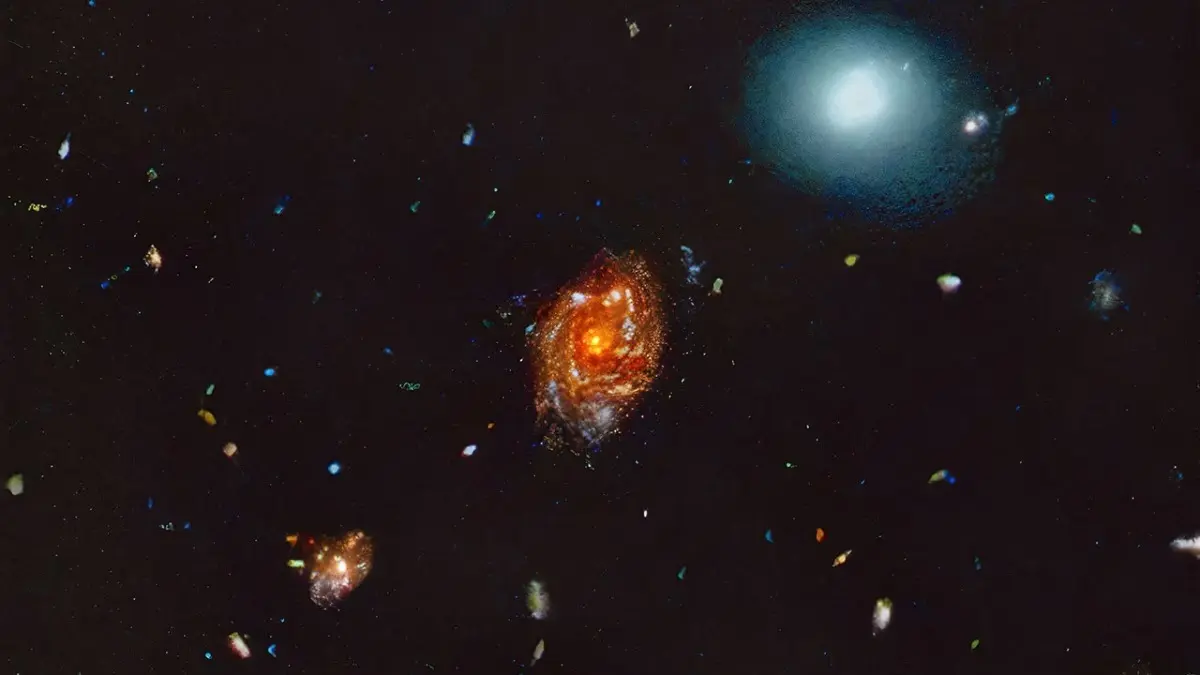
The James Webb Space Telescope (JWST) has unveiled a new chapter in our understanding of the early universe with the discovery of the ancient galaxy LAP1-B. By utilizing advanced infrared spectroscopy, researchers have successfully captured imagery of this incredibly faint celestial object, which dates back to the Era of Reionization, approximately 800 million years after the Big Bang.
Led by Associate Professor Kimihiko Nakajima of Kanazawa University, the research team published their findings on May 13 in the journal Nature. The study, which relied on over 30 hours of intensive spectral data collection, identifies LAP1-B as having the lowest metallicity—the concentration of elements heavier than hydrogen and helium—ever documented in the early universe.
Did You Know? The oxygen levels measured in the ancient galaxy LAP1-B are remarkably low, representing only 1/240th of the proportion of oxygen found in our current Sun, setting a record for the lowest oxygen content ever documented in space observation history.
The Mechanics of Ancient Discovery
Because of its immense distance and low light intensity, direct observation of LAP1-B would have been impossible without the assistance of a natural phenomenon known as gravitational lensing. Astronomers positioned a massive cluster of galaxies between Earth and the target, effectively using the cluster as a magnifying glass.

This cosmic lens bent and amplified the light from the distant galaxy, making it appear up to 100 times brighter. This allowed the JWST’s sensitive instruments to perform the detailed spectroscopic analysis required to determine the galaxy’s primitive chemical composition.
Expert Insight: The discovery of LAP1-B provides a rare “fossil” look at the conditions of the early cosmos. By examining a system with such minimal star mass—less than 3,300 times that of the Sun—we may be witnessing the foundational components of the universe, likely held together by dark matter rather than visible light-emitting matter.
Implications for Cosmic Evolution
The unique combination of an extremely low star mass and primitive chemical signatures aligns LAP1-B with the characteristics of Ultra-Faint Dwarf (UFD) galaxies. These systems are often viewed as “living fossils” because they preserve ancient stars estimated to be over 12 billion years old.
Professor Masami Ouchi, a senior researcher involved in the study, noted that the scientific community has long suspected that these ultra-faint dwarfs represent authentic remnants of the first galaxies born in the cosmos. While previously hampered by technological limitations, the JWST’s infrared capabilities have now provided the empirical evidence needed to link these objects to the early stages of galactic evolution.
Looking forward, this discovery may serve as a primary model for future studies on the formation of the first stars and the transition of the early universe. Scientists may use these findings to further refine theoretical models regarding the “Population III” stars and the role of dark matter in the birth of the very first galactic structures.
Frequently Asked Questions
What is the significance of the low metallicity found in LAP1-B?
The minimal presence of elements heavier than hydrogen and helium indicates that the galaxy formed during a very primitive stage of the universe, long before heavy elements became abundant through the life cycles of stars.
How were researchers able to see such a faint galaxy?
Astronomers utilized a massive galaxy cluster as a gravitational lens, which acted as a natural telescope to amplify the light from LAP1-B by up to 100 times, allowing the JWST to capture clear spectral data.
Why is LAP1-B considered a “fossil” of the universe?
We see categorized as a living fossil because it contains ancient stars that are more than 12 billion years old, offering a direct window into the structural conditions present shortly after the Big Bang.
How does the study of these ancient, ultra-faint galaxies change your perspective on the history of our own galaxy?