

Lennar Corporation Reports Second Quarter 2026 Financial Results
Lennar Reports Second Quarter 2026 Results Amid Housing Market Challenges
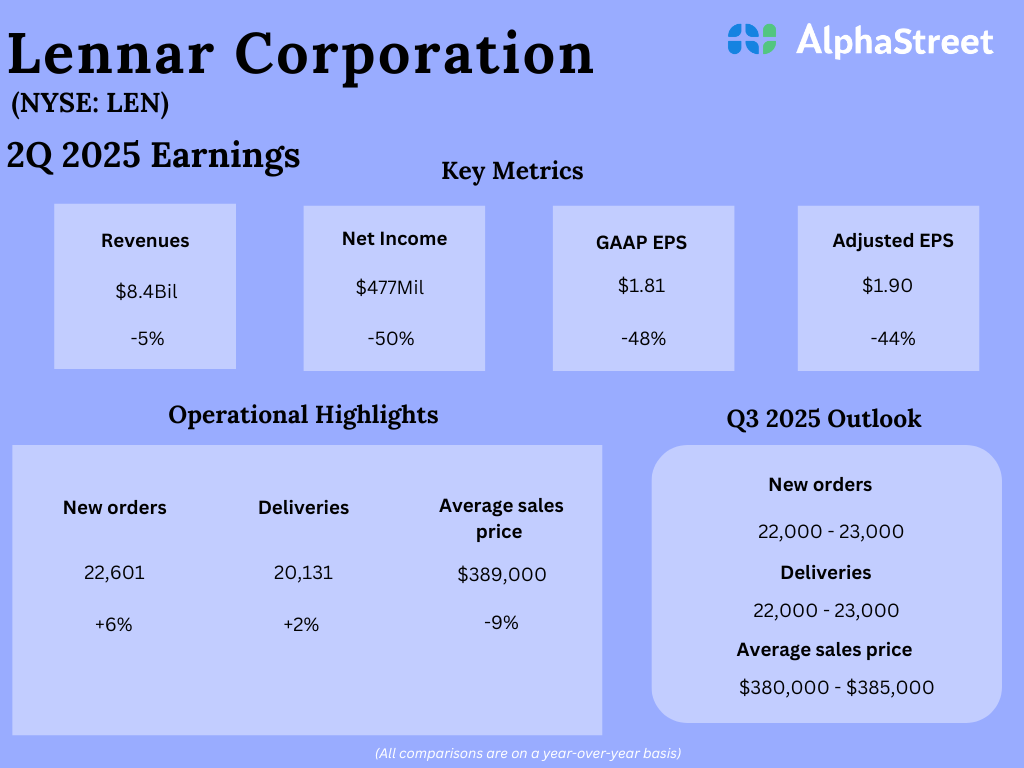
Lennar Corporation reported second-quarter 2026 net earnings of $305 million, or $1.24 per diluted share, compared to $477 million, or $1.81 per share, in the same period in 2025. Excluding mark-to-market losses on technology investments, adjusted earnings were $322 million, or $1.31 per share, according to the company’s financial disclosures.
Homebuilding revenue totaled $7.6 billion in the quarter, a 2% decline from $7.8 billion in the second quarter of 2025. New home deliveries rose 2% to 20,519 units, while new orders fell 4% year over year to 21,749 homes. The company’s gross margin on home sales improved to 15.6%, up from 17.8% in the prior-year period, driven by cost-saving initiatives despite higher land costs and lower revenue per square foot.
Stuart Miller, Lennar’s Executive Chairman and CEO, cited persistent challenges in the housing market, including elevated mortgage rates and affordability constraints, as key factors affecting performance. “We delivered results that demonstrate the strength and resilience of our operating platform,” Miller said, highlighting a 13% reduction in construction costs over several years and a record low homebuilding cycle time of 121 days.
Why It Matters: Market Pressures and Operational Adjustments
Lennar’s results reflect broader challenges in the U.S. housing sector, where affordability remains a critical barrier. The company’s average sales price of $371,000 in the second quarter included 12.9% in incentives and base price adjustments to maintain volume. Despite a 5% drop in average sales prices, Lennar’s net margin on home sales rose to 6.4%, up from 5.8% in the second quarter of 2025.
The firm’s asset-light strategy, which reduced land holdings on its balance sheet to less than 5%, and cost management efforts contributed to a 2% sequential improvement in gross margins. However, the company’s backlog of 16,818 homes valued at $6.6 billion underscores ongoing demand, albeit tempered by economic headwinds.
What May Happen Next: Guidance and Strategic Outlook
Lennar expects third-quarter 2026 deliveries to range between 20,500 and 21,500 homes, with gross margins improving to approximately 16% as volume increases and incentive levels moderate. The company also projects an average sales price of $375,000 to $380,000, with selling, general, and administrative expenses declining to 8.8%–9.0% of home sales revenue.
Analysts note that Lennar’s focus on cost discipline and technology investments, including its LENX initiative, could position the firm to benefit from a potential normalization of housing market conditions. However, external risks such as interest rate volatility and geopolitical tensions remain key uncertainties.
Lennar also repurchased 5 million shares for $447 million in the quarter and redeemed $400 million in senior notes, maintaining a debt-to-total-capital ratio of 15.8%. The company ended the quarter with $1.8 billion in cash, signaling strong liquidity amid market uncertainty.
Frequently Asked Questions
What caused the decline in new orders? New orders fell 4% year over year to 21,749 homes, attributed to persistent affordability challenges and cautious consumer sentiment in the housing market.
:max_bytes(150000):strip_icc()/stuart-a-miller_final-680b77ac54424cea811f43322966001d.png "Frequently Asked Questions")
How is Lennar managing debt? The company has no outstanding borrowings under its $3.1 billion revolving credit facility, with a homebuilding debt-to-total-capital ratio of 15.8% as of May 31, 2026.
What are the key risks to Lennar’s outlook? Risks include prolonged high interest rates, supply chain disruptions, and geopolitical tensions, which could further impact demand and pricing power.
As the housing market navigates ongoing economic uncertainty, Lennar’s ability to balance volume growth with margin improvement will be critical to its long-term performance. How might shifting consumer behavior affect the company’s strategy in 2027?