
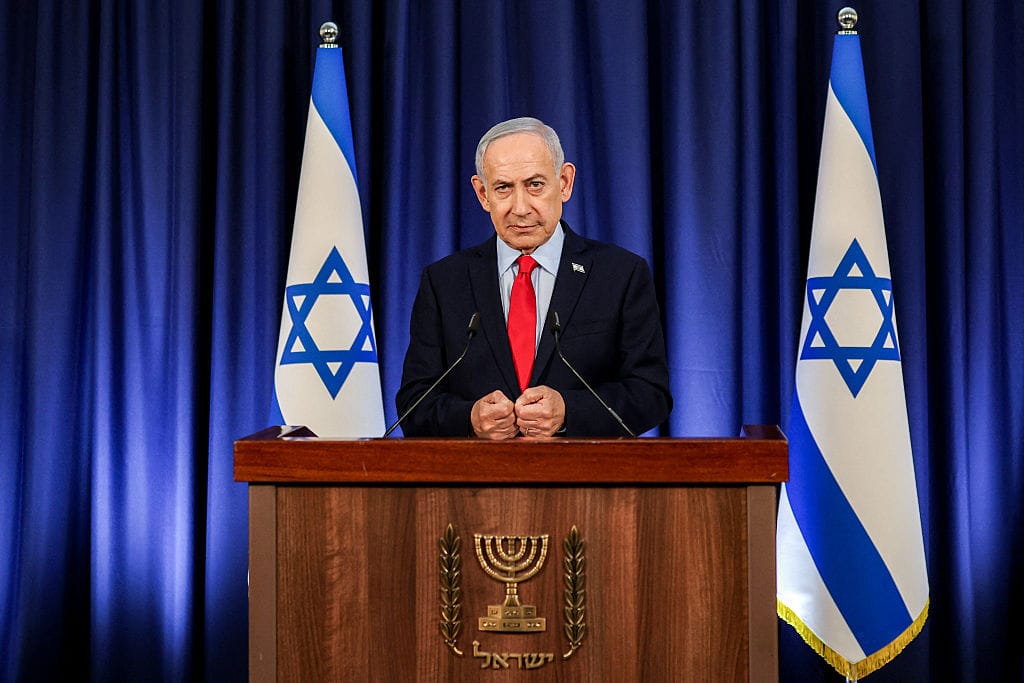
Netanyahu’s Sabotage of Peace and the Escalating Iran-Israel Conflict
Israel launched an intense bombardment of Beirut and Lebanese towns, killing over 300 people, shortly after U.S. President Donald Trump accepted a two-week ceasefire with Iran. According to Lebanon’s Health Ministry and military reports, the escalation suggests a strategic rift between Prime Minister Binyamin Netanyahu’s push for Iranian regime change and the U.S. administration’s diplomatic pivot.
Why did Israel strike Lebanon during a U.S.-Iran ceasefire?
Prime Minister Binyamin Netanyahu seeks a complete victory and regime change in Iran to ensure his political survival ahead of Israel’s general election later this year. While Donald Trump accepted a ceasefire to avoid a wider conflict, Netanyahu’s strategy relies on escalating pressure to force the collapse of the Iranian theocracy.

The scale of the recent assault was immediate and severe. Lebanon’s Health Ministry reported that Israel carried out 100 attacks within the first ten minutes of the operation. The strikes killed more than 300 people and wounded over a thousand. The Israeli Defence Forces (IDF) also targeted Gaza, including a drone strike on Al Jazeera journalist Mohammed Wishah, who is the 262nd journalist killed by Israel since October 2023.
How is the IRGC countering U.S. and Israeli air power?
The Iranian Revolutionary Guard Corps (IRGC) has shifted to a “deliberate doctrine” of asymmetric warfare, targeting the specific infrastructure that enables U.S. air operations. Kelly Grieco, a specialist at the Stimson Centre, told Defense News that the IRGC is systematically targeting radar, communications infrastructure, aerial tankers, and airborne early warning systems.

The IRGC has already claimed successful strikes on high-value targets:
- The U.S. Navy’s Fifth Fleet headquarters in Bahrain.
- A $1.1 billion early warning radar facility in Qatar.
- Two radar sites located in the UAE.
- The Prince Sultan Air Base in Saudi Arabia, where the IRGC destroyed an E-3 Sentry Airborne Warning and Control plane and damaged five KC-135 Stratotanker refueling aircraft.
What is the current state of Iran’s missile and drone arsenal?
Despite U.S. claims that Iranian capabilities are dwindling, intelligence and media reports suggest the IRGC maintains a massive stockpile. CNN reports that approximately half of Iran’s missile launchers remain intact, and thousands of one-way attack drones are still available, with some being produced in small-scale workshops.
Israeli military briefings, as cited by Israeli media, provide a stark contrast to the narrative of a crippled military. These assessments indicate Iran still possesses more than 1,000 missiles capable of reaching Israel. Additionally, Hezbollah’s arsenal in Lebanon is estimated to include as many as 10,000 shorter-range rockets.
| Capability | Estimated Stockpile/Status | Source |
|---|---|---|
| Long-range Missiles | 1,000+ (reaching Israel) | Israeli Military Briefings |
| Hezbollah Rockets | Up to 10,000 | Israeli Media |
| Missile Launchers | ~50% intact | CNN |
Could the UK stop a massive U.S. bombing campaign?
The UK holds a unique position of influence due to RAF Fairford in Gloucestershire. This base is the only European facility with the specialized equipment required to house B-2 Spirit stealth bombers and easy access to the munitions depot at RAF Welford.

Strategic air power for the U.S. depends heavily on the B-1B Lancer long-range bombers. Reports indicate only 21 of these aircraft are “mission ready,” and 15 of those are stationed at RAF Fairford. If UK Prime Minister Keir Starmer closed British airspace to U.S. war planes, it would significantly hinder the U.S. Air Force’s ability to launch a sustained campaign against Iranian infrastructure.
Frequently Asked Questions
How many journalists have been killed in this conflict?
According to reports on the strike against Mohammed Wishah, 262 journalists have been killed by Israel since October 2023.
What is the IRGC’s main military strategy?
The IRGC focuses on asymmetric defensive warfare, specifically targeting “critical enablers” of U.S. air power, such as radar and refueling tankers, to wear down stronger opponents.
Why is RAF Fairford important?
It is the primary European hub for B-1B Lancer bombers and can support B-2 Spirit stealth bombers, making it essential for any large-scale U.S. bombing mission in the region.
Do you think diplomatic efforts can still prevent a full-scale war between the U.S. and Iran?
Share your thoughts in the comments below or subscribe to our newsletter for the latest geopolitical analysis.