
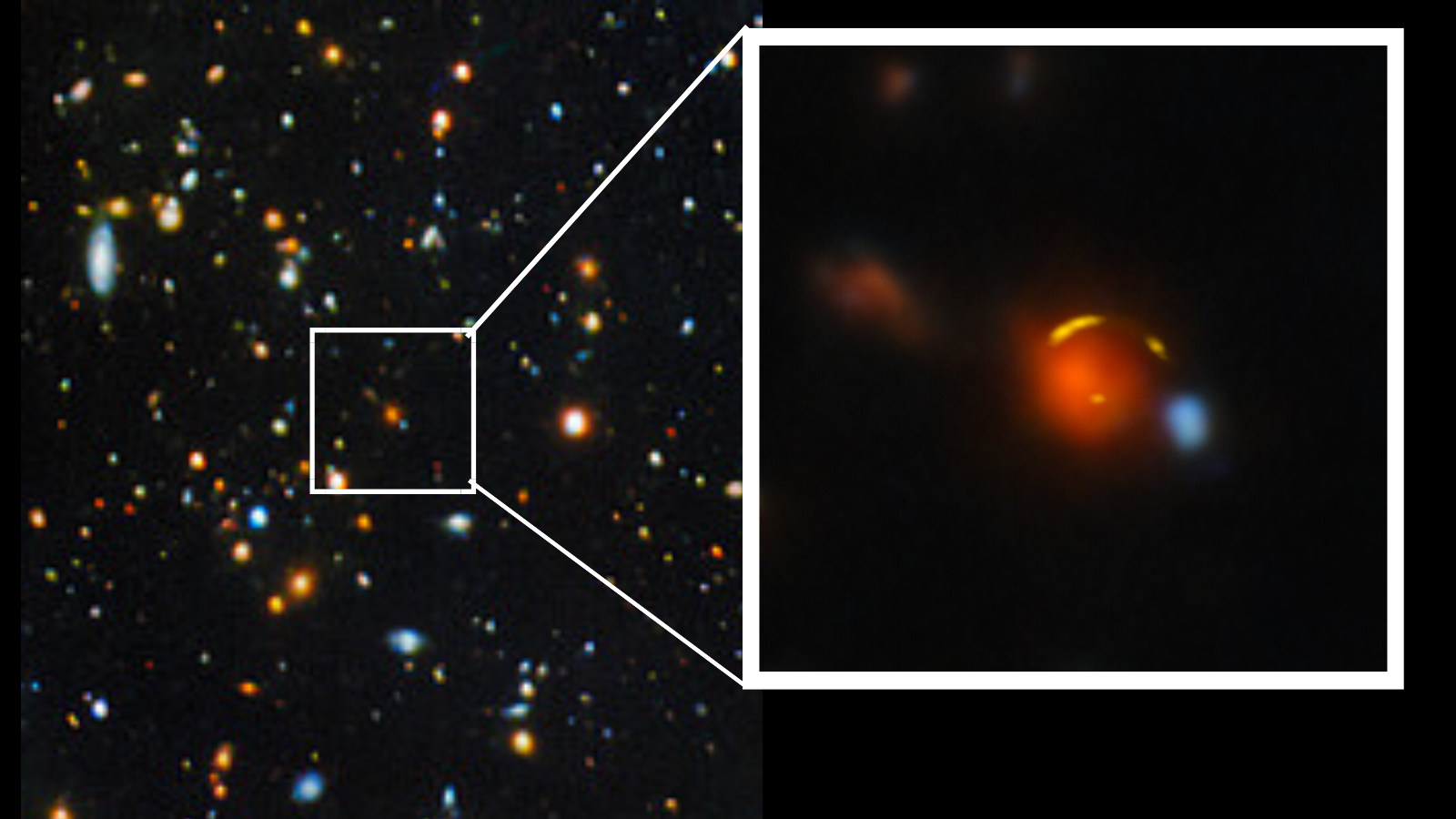
Scientists trace high-energy ghost particle to the ‘Shadow Blaster’ galaxy
Astronomers have linked a high-energy neutrino, IC 210922A, to a star-forming galaxy called Shadow Blaster, located 11 billion light-years away. According to a June 17 report in Nature Astronomy, the discovery suggests dusty star-forming galaxies may produce up to 20% of the universe’s diffuse neutrino background.
How was Shadow Blaster identified as a neutrino source?
The process began in 2021 when the IceCube Neutrino Observatory in Antarctica detected a high-energy neutrino event designated IC 210922A. This triggered a wide-scale search in the constellation Eridanus for an electromagnetic counterpart. Initial scans using X-ray and optical telescopes found nothing—no supernovae, gamma-ray bursts, or tidal disruption events.
Yuji Urata of MITOS Science Co., LTD. in Taiwan and his colleagues shifted the search to infrared and radio wavelengths. They utilized the James Clerk Maxwell Telescope (JCMT) and the Submillimeter Array (SMA) to find a galaxy in the correct position with sufficient brightness. The team later confirmed the findings using the Atacama Large Millimeter/submillimeter Array (ALMA), a network of 66 antennas in Chile.
What makes Shadow Blaster different from other cosmic accelerators?
Most high-energy neutrinos are theorized to come from Active Galactic Nuclei (AGNs), which feature supermassive black holes emitting powerful jets of plasma. Shadow Blaster, officially known as JCMT0402−0424, lacks these jets and does not have a feeding supermassive black hole.
Instead, Shadow Blaster possesses a compact core filled with dense clouds of gas and dust. According to Urata, this gas-rich environment is capable of efficiently producing high-energy neutrinos. This marks the first time an individual dusty star-forming galaxy has been directly linked to a high-energy neutrino event, proving that “sleeping” black holes in starburst regions can still act as particle accelerators.
Comparison: AGN vs. Star-Forming Galaxies
| Feature | Active Galactic Nuclei (AGN) | Shadow Blaster (Starburst) |
|---|---|---|
| Power Source | Feeding supermassive black hole | Dense gas and intense star formation |
| Emission Method | Powerful relativistic jets | Compact, gas-rich core acceleration |
| Neutrino Link | Commonly cited source | Newly verified source (IC 210922A) |
How did gravitational lensing help the discovery?
Shadow Blaster is too distant and faint to be seen by standard means. The team could only detect it because of gravitational lensing. This occurs when a massive object sits between Earth and a distant source, warping spacetime and bending the light from the background object.

This effect acts like a natural magnifying glass. To accurately analyze the galaxy, researchers first had to model the intermediate lens. They used the Gemini North telescope’s Multi-Object Spectrograph (GMOS) and Near-InfraRed Spectrograph (GNIRS) to determine the lens’s mass and distance. Once the lens was accounted for, the true nature of Shadow Blaster’s compact, star-forming heart became visible.
What does this mean for our understanding of the early universe?
This discovery helps fill a massive gap in cosmic accounting. Neutrinos are the second most abundant particles in the universe after photons, yet scientists have found very few sources to explain their numbers. Starburst galaxies were far more common roughly 10 billion years ago than they are today.

Urata’s analysis suggests that this population of early star-forming galaxies could contribute roughly 20% of the diffuse neutrino background measured by IceCube. While most of these galaxies are too faint to see without a gravitational lens, Shadow Blaster provides the evidence that these regions are a primary engine for high-energy particles in the early cosmos.
Frequently Asked Questions
What is a neutrino?
A neutrino is a nearly massless, neutral subatomic particle that travels at nearly the speed of light and rarely interacts with matter.

How far away is Shadow Blaster?
The galaxy is located 11 billion light-years from Earth, meaning the neutrino detected in 2021 had been traveling since the universe was roughly 3 billion years old.
Why is this discovery significant?
It is the first time a dusty star-forming galaxy, rather than a black hole jet (AGN), has been directly linked to a high-energy neutrino event.
Do you think we will find more “ghost particle” sources in the coming years? Let us know your thoughts in the comments below or subscribe to our newsletter for more deep-space updates.