
The Evolution of EV Battery Prices: Why Costs Plummeted and What’s Next
The Great Battery Crash: Why EVs Are Finally Becoming Affordable
For years, the primary barrier to the mass adoption of electric vehicles (EVs) wasn’t a lack of interest or charging infrastructure—it was the “battery tax.” The sheer cost of the cells made EVs a luxury play for the wealthy or a subsidized choice for the environmentally conscious.
However, we have witnessed one of the most aggressive price collapses in industrial history. To put it in perspective, the cost of lithium-ion battery capacity has plummeted to a fraction of its original value. In the early 90s, a single kilowatt-hour (kWh) cost thousands of dollars; today, that same capacity costs under $100.
Wright’s Law: The Secret Engine of Innovation
Many people attribute this drop to “magic” or a few lucky breakthroughs. In reality, It’s driven by Wright’s Law. Unlike Moore’s Law, which focuses on time (e.g., “every two years”), Wright’s Law focuses on experience.

The law suggests that for every doubling of cumulative production, the cost of a technology drops by a constant percentage—known as the “learning rate.” For lithium-ion batteries, this rate is approximately 19%.
Essentially, the more batteries we build, the better we get at building them. This is why Our World in Data shows such a steep decline; the industry didn’t just wait for time to pass—it scaled production exponentially.
Beyond the Hype: The Chemistry Driving the Change
While scaling production lowered costs, the “recipe” inside the battery also changed. The industry has moved through several chemical eras to balance cost, safety, and energy density.
The Shift from Cobalt to LFP
Early batteries relied heavily on Cobalt (LCO), which is expensive and ethically problematic to mine. The industry then pivoted to NMC (Nickel-Manganese-Cobalt) and NCA (Nickel-Cobalt-Aluminum) to increase range and lower costs.
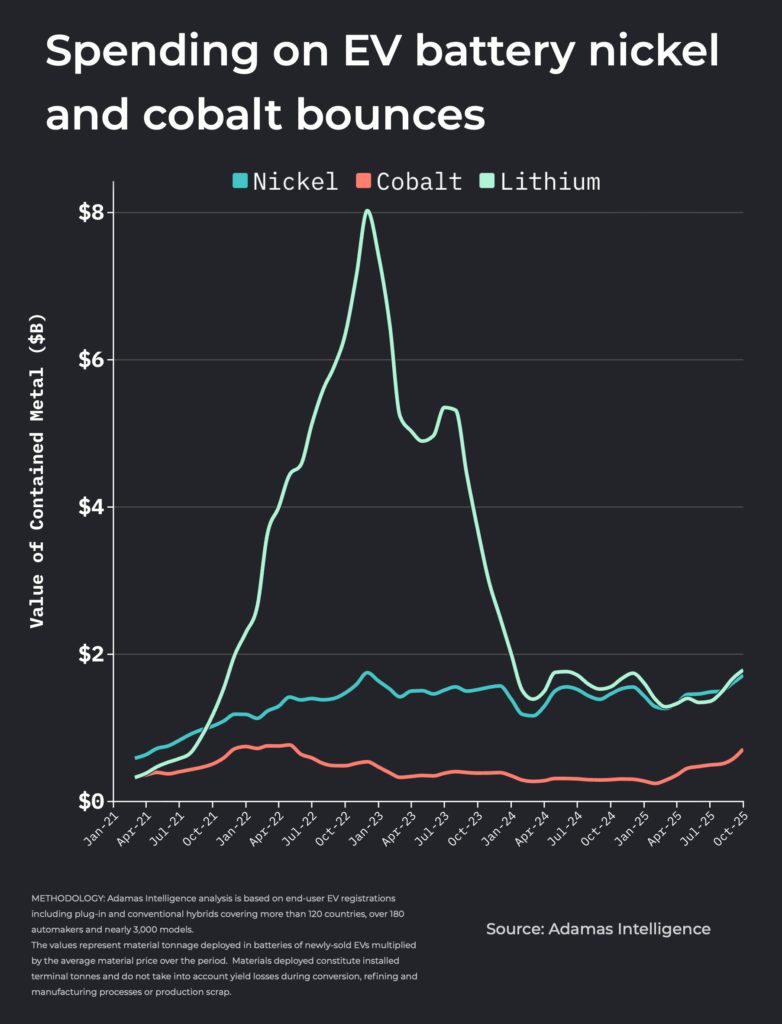
The real game-changer, however, has been the resurgence of Lithium Iron Phosphate (LFP). LFP batteries contain no cobalt or nickel, making them significantly cheaper, safer, and more durable.
Chinese giants like CATL and BYD have perfected LFP, allowing for the emergence of “budget EVs” priced around $10,000 in some markets. This shift alone has reduced costs for entry-level models by more than a third.
The Weight of the Problem: Energy Density and the Physics Ceiling
While prices are falling, we are hitting a different wall: energy density. This is the amount of energy you can cram into a kilogram of material. While we’ve tripled the density since 1991, we are still fighting an uphill battle against physics.
Compare a battery to gasoline. Gasoline has a gravimetric energy density of roughly 12,000 Wh/kg. Even the best modern batteries struggle to hit 300 Wh/kg. This is why EVs are significantly heavier than internal combustion engine (ICE) cars.
Where the “Battery Wall” Hits Hardest
- Passenger Cars: The technology is “good enough.” The weight penalty is offset by the efficiency of the electric motor.
- Heavy Trucking: More difficult. Every extra kilogram of battery is one less kilogram of cargo the truck can legally carry.
- Aviation: The hardest frontier. For regional flights, we need batteries to hit 400 Wh/kg; for long-haul, 600-800 Wh/kg. Currently, these values only exist in laboratories.
What’s Next? Sodium-Ion and the Solid-State Holy Grail
As lithium prices fluctuate and we approach the “material floor” (the point where the raw chemicals themselves can’t get any cheaper), the industry is looking for alternatives.

Sodium-Ion: The Budget King
Sodium is everywhere—it’s basically salt. Sodium-ion (Na-ion) batteries have lower energy density than lithium, but they are far cheaper to produce. We expect these to dominate small city cars and stationary grid storage, where weight doesn’t matter but cost does.
Solid-State: The Quantum Leap
The “Holy Grail” remains the solid-state battery. By replacing the liquid electrolyte with a solid material, these batteries promise faster charging, higher safety (no fire risk), and a massive jump in energy density.
While companies like Toyota and Samsung are investing billions, mass production remains elusive. We are currently in the “early 90s” phase of solid-state tech—high potential, but high uncertainty.
For more on how energy storage is changing the grid, check out our guide on the future of home energy systems.
Battery Evolution FAQ
Q: Will EV batteries continue to get cheaper?
A: Yes, but the rate of decline will slow. We are approaching the “bottom” where the cost is determined by the raw materials rather than manufacturing efficiency.
Q: Which is better: LFP or NMC batteries?
A: It depends on your needs. LFP is better for budget, longevity, and safety. NMC is better for long-range travel and cold-weather performance.
Q: Can batteries eventually replace jet fuel?
A: For short regional hops, possibly. For long-haul flights, the energy density of batteries is currently too low to be practical compared to liquid fuels.
Join the Conversation
Do you think solid-state batteries will arrive in time to kill the combustion engine for good, or is the physics gap too wide to bridge?
Let us know in the comments below or subscribe to our newsletter for weekly deep dives into the future of mobility!