
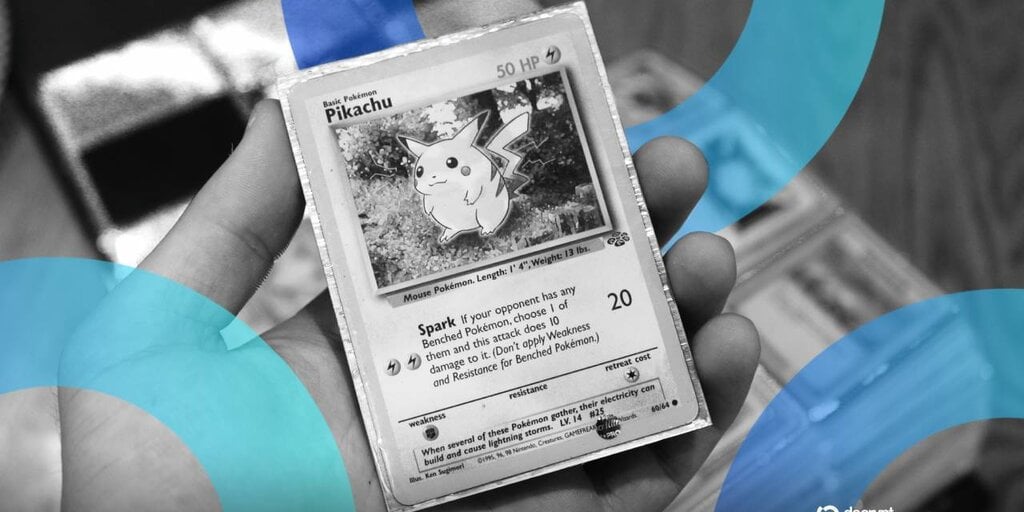
Tokenized Pokémon Cards: Gacha Sales Surge 10x in One Year
Seven tokenized Pokémon card platforms generated $230 million in gacha sales in May, a ten-fold increase from the $32 million recorded a year ago, according to research from Messari. This growth marks a surge in the use of blockchain technology to facilitate the trade of high-value physical collectibles through randomized digital “spins.”
Collector Crypt, a leading player in the space, reported more than $1.000 billion in total sales over the last 18 months. CEO Tuom Holmberg told Decrypt that gacha machines drive between 90% and 95% of the company’s business.
How are gacha mechanics driving Pokémon card sales?
Gacha mechanisms replicate the experience of opening physical card packs by awarding random NFTs backed by physical cards. A recent video from the official Solana account on X highlighted this by asking users if they would spin for a Pokémon card valued at $15,000.

Dominic Jang, co-founder and CSO of Deadstock, told Decrypt that these digital packs attract both collectors and speculators. Jang noted that the primary innovation is “instant liquidity,” allowing users to exit positions quickly after a win.
Why is the tokenized collectibles market expanding?
The global collectibles market reached $15.8 billion in 2024 and is projected to hit $23.5 billion by 2030, according to Strategic Market Research. While the pandemic-era boom in digital art has cooled, NFT technology is now being used to support the speculative environment of physical cards.
Messari analyst AvgJoesCrypto attributed the growth to reduced friction compared to traditional marketplaces. According to the analyst, platforms like Collector Crypt simplify ownership and reduce the forgery risks often associated with eBay transactions.
What risks and challenges face these platforms?
Despite the sales growth, the technology faces significant skepticism from traditional collectors. Tuom Holmberg stated that approximately 90% of people at card fairs view tokenized cards on Solana as a “fraud,” “scam,” or “rug-pull.”
To counter this, Collector Crypt offers instant buy-backs at a 10% to 15% discount from market prices. Holmberg also claimed that some of the 30 competing platforms use his company’s Montana vault for liquidity and trust, as other competitors may store inventory in closets.
What may happen next for tokenized assets?
The format may expand beyond Pokémon cards as other platforms diversify. Courtyard recently expanded its tokenization model to include antique U.S. coins, luxury watches, and comic books.
Market growth could be influenced by high-profile sales, such as the $16.5 million auction price for a rare Pokémon card obtained by Logan Paul in February. If mainstream adoption increases, more platforms may seek institutional-grade vaulting to avoid the “rug-pull” reputation associated with early crypto projects.
Frequently Asked Questions
How much did tokenized Pokémon gacha sales grow in one year?
Sales rose from $32 million a year ago to $230 million in May, according to Messari.
What is the projected value of the global collectibles market by 2030?
Strategic Market Research projects the market will reach $23.5 billion by 2030.
How does Collector Crypt handle the physical cards?
The company stores the cards in a 28,000-square-foot vault in Montana to back the tokenized assets.
Do you think digital tokens are a safe way to own high-value physical collectibles?