
Two-component exciton condensates in an electron-hole bilayer
Recent breakthroughs in condensed matter physics have confirmed the existence of excitonic insulators and equilibrium exciton condensation in van der Waals heterostructures. Researchers have successfully demonstrated perfect Coulomb drag and exciton transport in these specialized atomic double layers, marking a significant evolution from the foundational observation of Bose-Einstein condensation in dilute atomic vapors first reported in 1995.
The transition from early experiments with liquid helium, which established the study of quantum fluids like superfluidity in the 1930s, to contemporary work with monolayer WTe2 and double bilayer graphene, highlights a sustained effort to control quantum states at the atomic scale. According to findings published in Science and Nature, these systems allow for the manipulation of electron-hole fluids, providing a platform to observe complex quantum phenomena such as the Berezinskii-Kosterlitz-Thouless transition.
The Mechanism of Excitonic Condensates
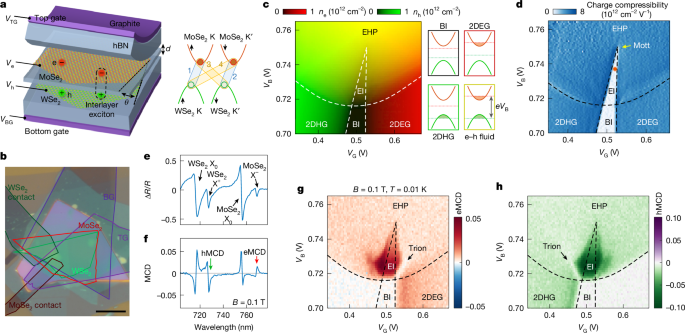
Excitonic insulators emerge when electrons and holes bind together to form excitons, which then condense into a collective quantum state. As documented by L.V. Keldysh and Y.V. Kopaev in 1964, the instability of a semimetallic state toward Coulomb interaction creates the environment necessary for this transition. Recent experiments using transition metal dichalcogenides have furthered this understanding by utilizing the spin and valley degrees of freedom inherent in these materials, as noted by D. Xiao and colleagues in their 2012 research.
The ability to electrically control these fluids has been a critical development. By tuning the density of electrons and holes in van der Waals heterostructures, scientists can induce phase transitions between different quantum states, including the emergence of trion liquids. This level of control, described in 2025 research, allows for the precise measurement of quantum oscillations and the observation of perfect Coulomb drag, a hallmark of the superfluid-like behavior of the exciton condensate.
Future Implications for Quantum Computing
The development of electrically controlled electron-hole bilayers may lead to new architectures for quantum information processing. Because these systems exhibit strong interactions and can be tuned via external fields, they offer a viable path for manipulating quantum information at higher temperatures than previously possible. Analysts expect that continued research into the competition between excitonic insulators and quantum Hall states will refine our ability to protect these fragile quantum states from decoherence.
A possible next step involves the integration of these materials into complex device geometries to test the limits of exciton transport. As researchers continue to optimize point defect control in transition metal diselenides, the stability of these condensates is likely to improve, potentially opening the door to new types of low-dissipation electronic components.
Frequently Asked Questions
What is an excitonic insulator?
An excitonic insulator is a state of matter where electrons and holes, bound together by Coulomb attraction, form a collective quantum condensate rather than acting as independent charge carriers.
Why is “perfect Coulomb drag” significant?
Perfect Coulomb drag serves as a signature of the superfluid nature of the exciton condensate, indicating that the motion of one layer of carriers is perfectly coupled to the motion of another layer through the exciton fluid.
How do van der Waals heterostructures facilitate this research?
These structures allow for the precise stacking of atomically thin materials, which provides the necessary confinement and tunable electronic properties to stabilize quantum states like exciton condensates at accessible scales.
Could the manipulation of these quantum fluids lead to the development of a new class of ultra-low-power electronic devices?