

Visualization and 3D Rendering Software Market Size, Share, and Forecast 2025-2035
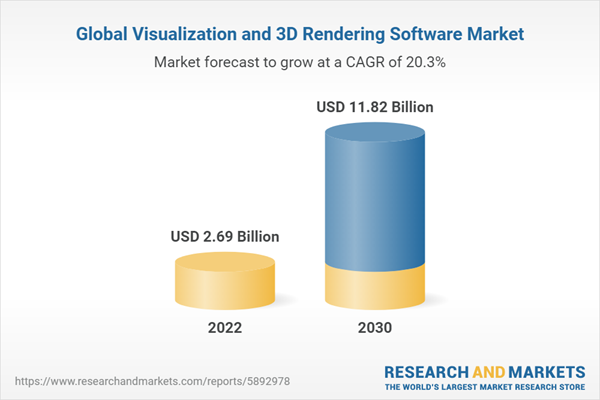
The global visualization and 3D rendering software market is projected to grow from $4.06 billion in 2025 to $24.39 billion by 2035, expanding at a CAGR of 19.63%. This surge is driven by the integration of artificial intelligence, the rise of real-time rendering, and a widespread shift toward digital twins in architecture, manufacturing, and entertainment.
Why is Real-Time Rendering Becoming the Industry Standard?
Speed is no longer a luxury; it’s a requirement. According to market data, 74% of design professionals now consider real-time rendering essential for project presentations and securing client approvals. This shift allows for immediate iteration, removing the hours-long wait times traditionally associated with high-fidelity renders.
The impact is most visible in architecture, where 68% of firms use real-time solutions to create interactive presentations. In the gaming sector, the stakes are even higher, with over 75% of studios leveraging rendering platforms to boost visual quality and user experience.
Major players are already delivering these gains. NVIDIA has introduced AI-based rendering technology that increases rendering efficiency by nearly 40% and enables 58% faster scene optimization for complex projects. Similarly, Chaos Group’s latest updates have delivered 37% faster rendering performance for professional users.
How is AI Transforming the 3D Workflow?
Artificial intelligence is moving from a buzzword to a core functional tool. Current data shows that 66% of newly introduced rendering solutions now include AI features for automated adjustments and workflow optimization. These tools handle the tedious parts of the process—lighting adjustments, texture optimization, and image enhancement.
For the end user, this means less manual tweaking. About 58% of software users are already using AI-driven features to automate their visual polish. This isn’t just about aesthetics; it’s about productivity. Autodesk has enhanced its platform with real-time rendering and cloud tools that have reduced rendering workflows by approximately 35%.
The AI Efficiency Gap
While the technology is advancing, adoption isn’t universal. While 59% of companies have integrated AI to boost productivity, a significant portion of the market still struggles with the “learning curve.” Around 47% of organizations report productivity losses as they struggle to master these complex new AI-driven tools.
Will Cloud Rendering Replace On-Premise Hardware?
The battle between local power and cloud flexibility is ongoing. As of 2025, on-premise deployment still holds the majority share at 57% ($2.31 billion), largely because 62% of large enterprises prioritize internal security and total control over their infrastructure.
However, the momentum has shifted toward the cloud. Cloud-based solutions accounted for 43% of the market ($1.75 billion) in 2025 and are growing at a faster CAGR of 20.6%. The driver here is collaboration; 61% of design teams use cloud platforms to coordinate projects across multiple geographic locations.
What Role Do Digital Twins and Immersive Tech Play?
Visualization is expanding beyond simple images into “living” models. Digital twin technology is a massive growth lever, with 67% of industrial organizations investing in digital modeling to improve asset management and operational visibility.
This is particularly critical in manufacturing, where 62% of companies use rendering software for digital prototyping before a single physical part is produced. This “test-before-build” approach is validated by Dassault Systèmes, whose simulation upgrades have improved virtual testing accuracy by about 32%.
Immersive technology is the final piece of the puzzle. Over 54% of software suppliers are now integrating VR and AR compatibility into their products. This allows 57% of product designers to embed immersive 3D visualizations directly into the development phase, rather than using them only for final marketing.
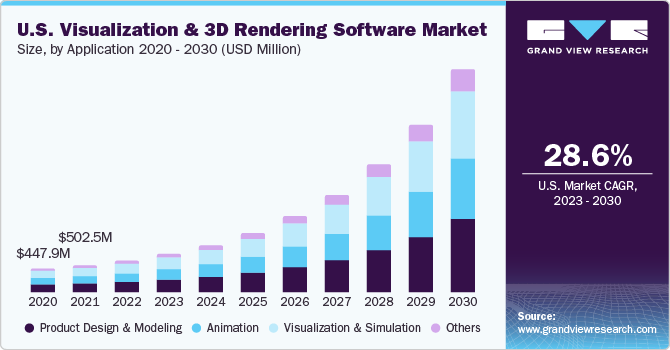
Market Segmentation at a Glance (2025)
| Segment | Market Share | 2025 Value | Projected CAGR |
|---|---|---|---|
| Product Design & Modeling | 35% | $1.42 Billion | 20.4% |
| Visualization & Simulation | 28% | $1.14 Billion | 19.5% |
| Animation | 23% | $930 Million | 19.8% |
| Others | 14% | $570 Million | 18.7% |
The Bottlenecks: Why Isn’t Adoption Faster?
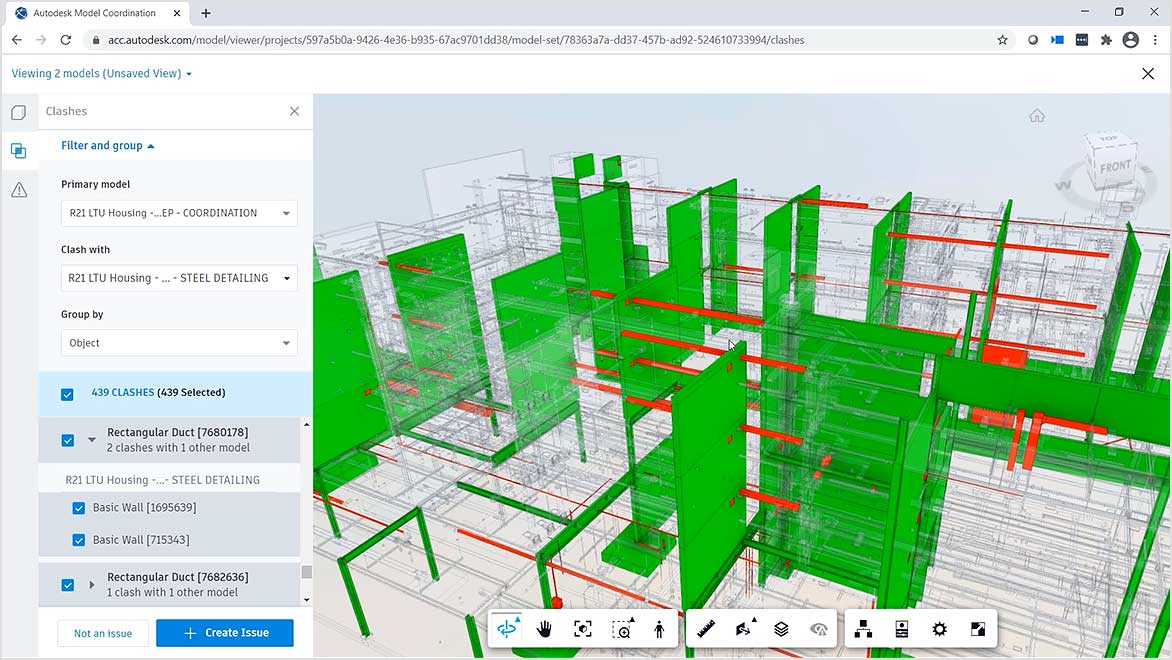
Despite the growth, the industry faces a “talent gap.” Roughly 50% of organizations struggle to find qualified professionals who can handle complex rendering and simulation workflows. This human capital shortage is compounded by technical friction; 53% of firms report significant issues when trying to integrate rendering software with their existing design platforms.
Infrastructure remains a hurdle for the smaller players. Beyond the cost, 52% of users report performance glitches when handling large-scale projects, and 48% struggle with the constant need for GPU upgrades and system maintenance.
FAQ
Which region dominates the 3D rendering market?
North America leads the global market with a 36% share, followed by Europe at 28% and Asia Pacific at 26%.
Who are the top companies in this space?
Autodesk, Inc. holds approximately 18% of the market share, while Dassault Systèmes follows with about 15%. Other key players include NVIDIA, Siemens AG, and Adobe.
What is the primary driver for the 19.63% CAGR?
The growth is primarily fueled by the demand for real-time visualization, the adoption of cloud-based collaboration, and the integration of AI to automate design workflows.
How does visualization software improve project outcomes?
According to industry data, 72% of organizations report improved design accuracy, and 66% have successfully shortened their design revision cycles.
Ready to optimize your design workflow?
The shift toward AI and cloud rendering is happening fast. Share your thoughts in the comments below: Is your firm sticking with on-premise power or moving to the cloud?