

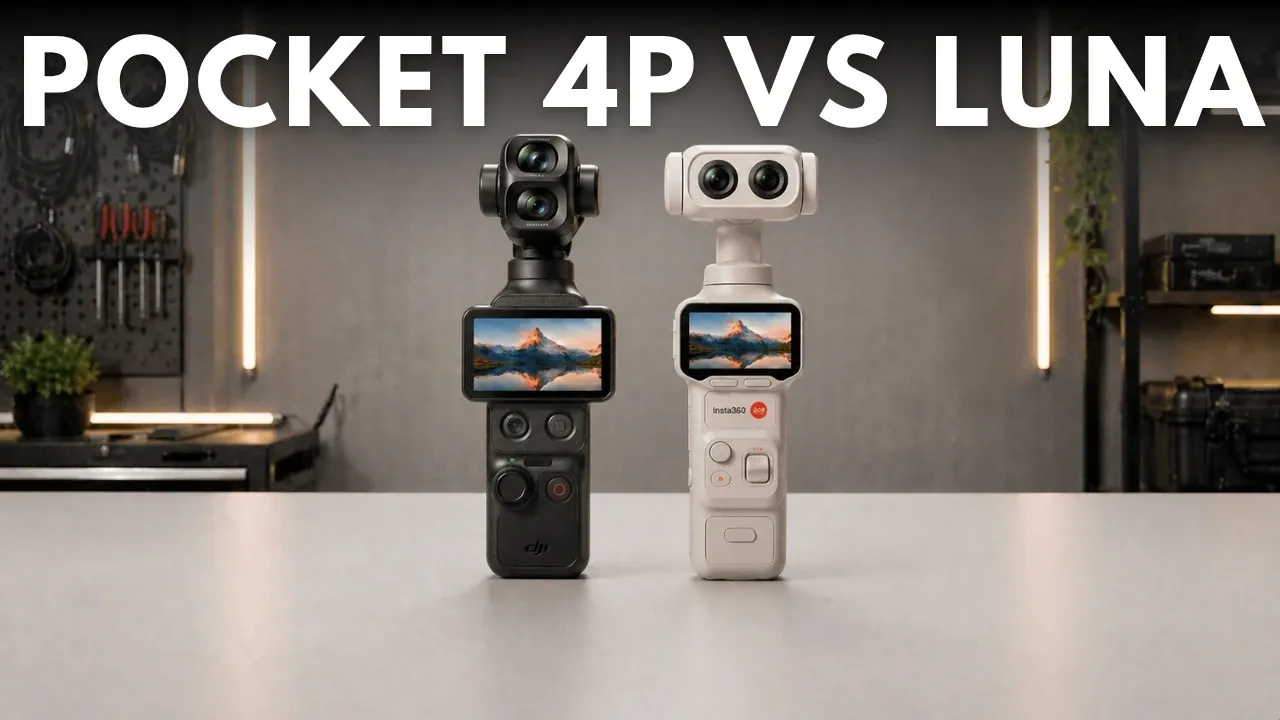
We now know how DJI’s dual camera Osmo Pocket 4P compares to Insta360’s
The competition between the DJI Pocket 4P and Insta360 Luna Ultra signals a shift toward professional-grade sensors and decoupled controls in vlogging hardware. According to technical specifications, these devices now prioritize high dynamic range—up to 17 stops in the Pocket 4P—and remote touchscreen operation to replace traditional on-camera monitoring for solo creators.
How are sensor sizes changing the vlogging market?
Compact cameras are moving away from basic wide-angle lenses toward multi-sensor arrays. The DJI Pocket 4P utilizes a 1-inch 4K sensor with a 20mm-equivalent f/2.0 lens. This hardware allows for 17 stops of dynamic range when using the D-Log 2 color profile, a notable increase over the 14 stops found in the standard Pocket 4.
Insta360 is pushing the resolution ceiling. The Luna Ultra features a 1-inch 8K sensor, providing more flexibility for cropping and stabilization in post-production. However, this resolution comes with a trade-off in speed. The Luna Ultra captures 8K at 30fps, while the Pocket 4P prioritizes motion, capturing 4K footage at up to 240fps.
Why is decoupled control becoming the new standard?
The industry is moving toward “remote-first” operation to solve the problem of solo framing. Insta360’s Luna Ultra introduces a removable touchscreen and control module that functions as a wireless remote with livestreamed previews.

DJI is following a similar path with the Pocket 4P “Vlog Kit,” priced at ¥4299 ($636). This bundle includes the Osmo FrameTap viewfinder remote. According to DJI, the FrameTap allows users to manually control recording and select specific focus points or tracking targets via a touchscreen, mirroring the functionality of the Luna Ultra’s detached remote.
This trend reduces the need for external monitors or “guess-work” framing, allowing creators to maintain eye contact with the lens while monitoring their composition from a distance.
What is the future of AI-driven tracking in handhelds?
Hardware is now being designed to support increasingly complex software. The Pocket 4P integrates ActiveTrack/Smart Follow 8.0, the result of a decade of stabilization development by DJI. This allows the camera to automatically reframe and zoom to keep subjects centered.
To support this AI tracking without losing image quality, manufacturers are implementing “lossless” sensor cropping. The Pocket 4P, for example, uses a 1/1.28-inch telephoto sensor to provide 3X optical zoom and 6X lossless zoom. This ensures that as the AI zooms in on a subject, the image doesn’t degrade into digital noise.
How does internal storage impact creator workflows?
High-resolution video files are forcing a change in onboard storage capacity. The Pocket 4P includes 103GB of built-in storage, which is more than double the 47GB provided by the Luna Ultra.
According to DJI, 103GB is sufficient to capture over 200 minutes of 4K/60fps footage. While both devices support expansion—the Pocket 4P via microSD—the increase in internal capacity suggests a move toward “instant-on” recording where creators no longer need to verify if a memory card is inserted before filming a spontaneous moment.
Quick Comparison: Pocket 4P vs. Luna Ultra
| Feature | DJI Pocket 4P | Insta360 Luna Ultra |
|---|---|---|
| Max Resolution | 4K @ 240fps | 8K @ 30fps |
| Dynamic Range | 17 Stops (D-Log 2) | Not Specified |
| Built-in Storage | 103GB | 47GB |
| Weight | 230g | 233g |
Frequently Asked Questions
Which camera is better for slow motion?
The DJI Pocket 4P is superior for slow motion, as it can capture 4K footage at 240fps, compared to the Luna Ultra’s 120fps limit at 4K.
Do I need a microSD card for the Pocket 4P?
Not necessarily for short projects. The 103GB of internal storage holds over 200 minutes of 4K/60fps video, though a microSD card is available for further expansion.
What is the advantage of the Luna Ultra’s 8K sensor?
According to the specifications, 8K resolution allows for greater freedom during post-production, specifically when cropping or stabilizing footage without losing HD quality.
How does the FrameTap remote work?
The FrameTap is a touchscreen remote that allows users to manually control recording and select focus/tracking targets remotely, removing the need to touch the camera body.
Which feature is more important for your workflow: 8K resolution or 240fps slow motion? Let us know in the comments below or subscribe to our newsletter for more deep dives into creator tech.