

What Happens When Apple and Google Team Up to Build AI? 5 New Models
Apple launched Apple Intelligence at its Worldwide Developers Conference (WWDC), introducing five new foundational models developed in partnership with Google. According to Craig Federighi, Apple’s senior vice president of software engineering, these models integrate into iOS 27, macOS Golden Gate, and Vision Pro to power a revamped Siri and multimodal AI tools.
What are the five new Apple Intelligence models?
Apple released a tiered family of “Apple Foundation Models” (AFM) designed to balance processing power with device battery life. These models serve as the underlying infrastructure for the new Siri and other system-wide AI features.

The on-device models include AFM 3 Core, a 3-billion parameter base model for iPhone and Mac, and AFM 3 Core Advanced. Federighi described the latter as the company’s “most powerful on-device model,” utilizing 20 billion parameters to handle multimodal tasks, meaning it can process both speech and images simultaneously.
For more complex tasks, Apple introduced three cloud-based models:
- AFM 3 Cloud: Standard cloud-based processing.
- AFM 3 Cloud (Image): Powers the Image Playground and new AI photo editing tools.
- AFM 3 Cloud Pro: The most advanced model, designed for “agentic tool use and complex reasoning.”
How does Apple handle AI privacy and data?
Apple utilizes a “private cloud compute” infrastructure to ensure user data and chat logs aren’t stored on servers. According to Apple, the company uses publicly available data, licensed data, and synthetic data to train these models.
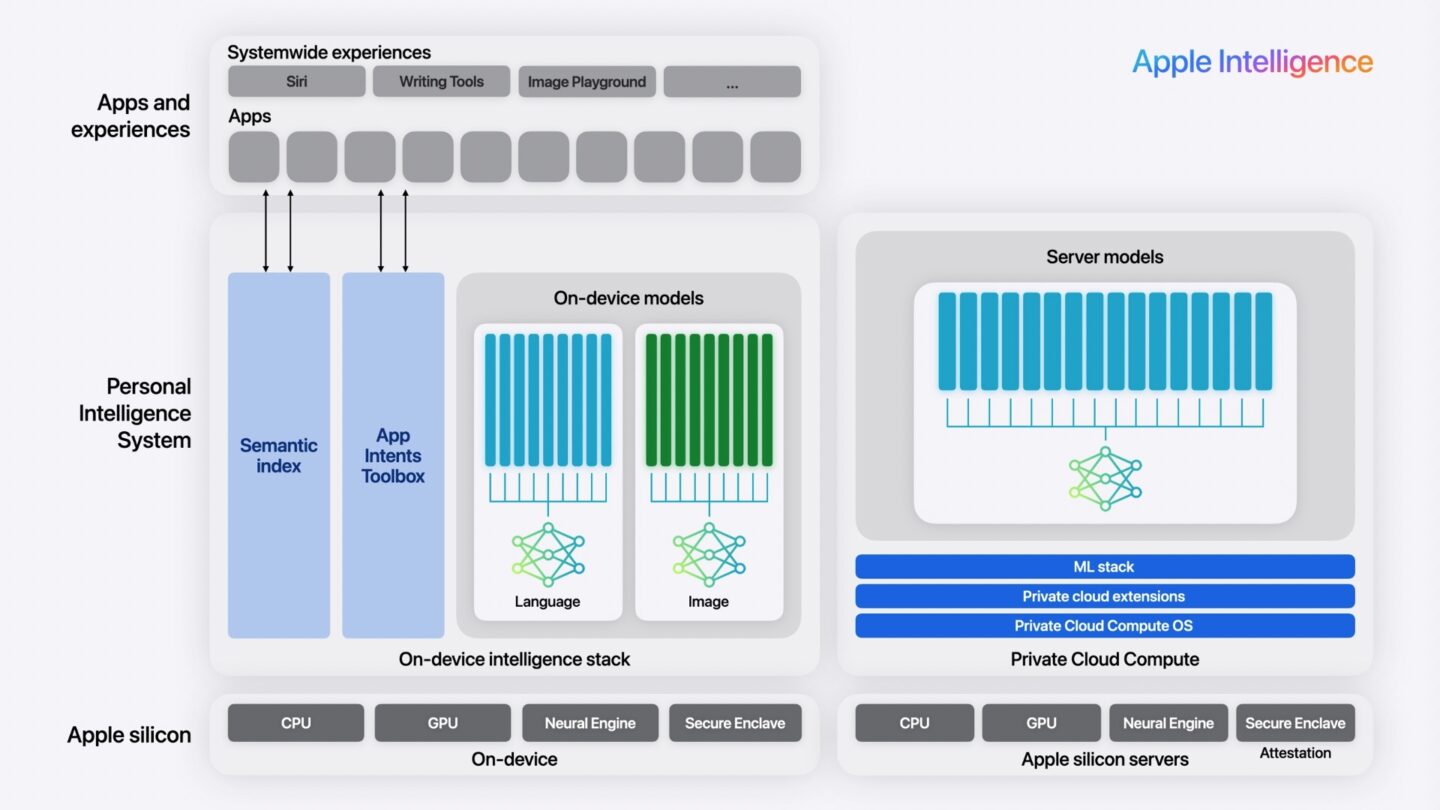
The company stated it doesn’t use information from user interactions with Apple AI for training. Apple also noted it respects the rights of web publishers who opt out of AI training, though the company provided no specific details on the enforcement mechanism for these opt-outs.
This approach contrasts with some competitors who have faced scrutiny over data scraping. By prioritizing on-device AI, Apple reduces the amount of data leaving the hardware, which Federighi cited as a cornerstone of the new system.
Why is Apple’s AI strategy different from Google or OpenAI?
While rivals focused on standalone chatbots like ChatGPT or Anthropic’s Claude, Apple is integrating AI directly into the operating system. Francisco Jeronimo, vice president of client devices at analyst firm IDC, stated in an email that Apple’s goal is for AI to be “trustworthy and invisible to the user.”
Instead of a separate app, the AI manifests as an upgraded Siri that understands context by accessing user information across different apps. Jeronimo noted that if Apple makes AI feel natural and private for mainstream users, it could redefine consumer expectations for all personal devices.
| Model Tier | Location | Primary Use Case |
|---|---|---|
| AFM 3 Core | On-Device | Basic iPhone/Mac tasks |
| AFM 3 Core Advanced | On-Device | Multimodal (Image/Speech) |
| AFM 3 Cloud Pro | Cloud (Google/Nvidia) | Complex reasoning & agents |
What happens next for iOS 27 and macOS Golden Gate?
The rollout of Apple Intelligence will center on the “system orchestrator,” a tool that coordinates between the different AFM models. This allows the AI to work across various apps, improving dictation accuracy and language understanding.
The impact will be most visible in the revamped Siri, which will be available across compatible iPhones, Macs, Apple Watches, and AirPods. This represents a shift from Siri as a voice-command tool to an agent capable of executing tasks based on user context.
Frequently Asked Questions
Does Apple use my personal messages to train AI?
No. According to Apple, the company does not use information from user interactions or private data to train its foundation models.
Which devices will support Apple Intelligence?
Apple has not released a full hardware compatibility list, but the models are designed for iPhone, Mac, and Vision Pro devices capable of running the AFM 3 Core models.
Is Apple Intelligence the same as ChatGPT?
No. While both are generative AI, Apple Intelligence is integrated into the OS to be “invisible” and focuses heavily on on-device processing and privacy, whereas ChatGPT is primarily a cloud-based chatbot.
What is a multimodal model?
As explained by Craig Federighi, a multimodal model can understand and process different types of input—such as text, speech, and images—simultaneously.
Join the Conversation: Do you prefer AI that acts as a standalone assistant or one that disappears into your operating system? Let us know in the comments below or subscribe to our newsletter for more deep dives into the future of AI.