
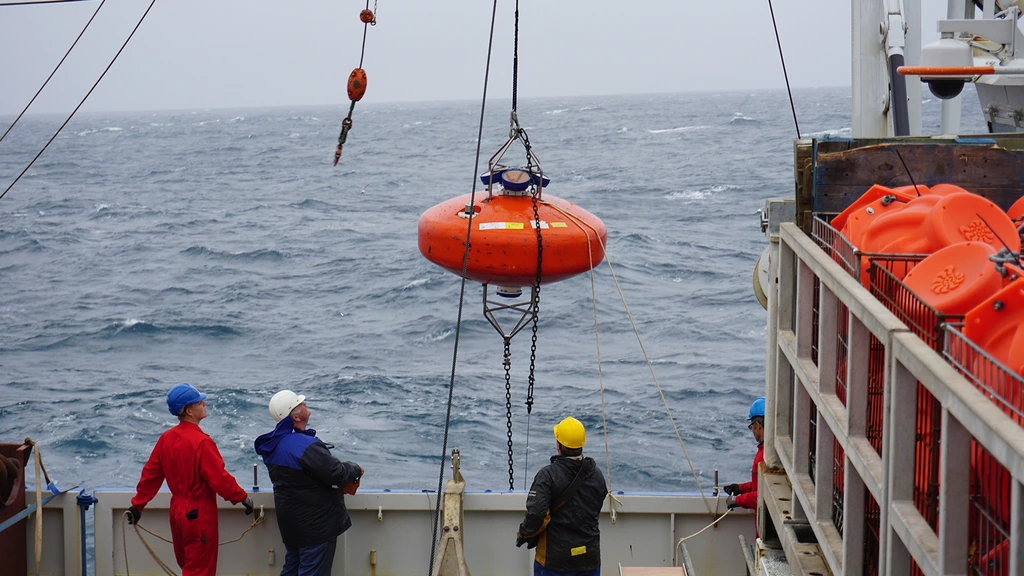
US Removes Critical Ocean Buoys, Threatening European Climate Research
The Great Blind Spot: Why Losing Ocean Data Could Freeze Europe’s Future
Imagine driving a car through a thick fog, but instead of slowing down, you decide to turn off your headlights. That is essentially what is happening to our understanding of the Atlantic Ocean. The decision to remove critical measuring instruments and buoys near Greenland isn’t just a budgetary line item; it’s a strategic blackout of the data we need to survive the coming decades.
For years, a sophisticated chain of sensors has stretched from Canada to Europe, acting as the “nervous system” of the North Atlantic. These tools track temperature, salinity, and flow—the vital signs of the Atlantic Meridional Overturning Circulation (AMOC). When we stop measuring, we stop predicting.
The AMOC Collapse: A Theoretical Nightmare Becoming Real
The “warm current” isn’t a guarantee; it’s a delicate balance of salt and heat. As Arctic ice melts, a massive influx of fresh water pours into the North Atlantic. Because fresh water is less dense than salt water, it doesn’t sink, which effectively “clogs” the conveyor belt.
If the AMOC weakens significantly or collapses, the results wouldn’t be a gradual warming, but a paradoxical cooling for Europe. We are talking about a potential shift in agricultural zones that could render current farming practices in Northern Europe obsolete. Imagine a French vineyard replaced by tundra-like conditions within a few generations.
Recent studies published in Nature suggest that the AMOC is at its weakest point in over a millennium. Without the buoys near Greenland—the “tipping point” of this system—we are essentially flying blind into a climate storm.
Science as a Political Pawn: The Trend of ‘Ideological Budgeting’
The removal of these instruments isn’t a financial necessity. When the cost of maintenance is measured in millions, but the potential economic loss from a climate shift is measured in trillions, the math doesn’t add up. This points to a larger, more concerning trend: the weaponization of scientific funding.
We are seeing a shift where data collection is no longer viewed as a global public good, but as a political statement. When a superpower decides that certain data “doesn’t fit the narrative,” the global scientific community suffers a collective stroke. The loss of these buoys is a symptom of a broader retreat from international climate diplomacy.
The Ripple Effect on Global Research
- Data Gaps: Long-term datasets are the gold standard of science. A gap of even three to five years can make it impossible to distinguish between a natural cycle and a permanent climate shift.
- Resource Strain: Institutions like the Netherlands Institute for Sea Research (NIOZ) are already struggling. Expecting smaller nations to fill the void left by the US is an unrealistic burden.
- Loss of Trust: When a primary partner becomes unreliable, international collaborations fracture, slowing the pace of discovery.
Future Trends: Where Do We Go From Here?
As traditional government funding becomes volatile, the future of oceanography will likely pivot toward three main trends:

1. The Rise of ‘Private Science’
We may see a surge in philanthropic funding—think Billionaire-funded ocean arrays. While this keeps the sensors in the water, it raises questions about who owns the data and whether it remains open to the public or becomes a proprietary asset.
2. Satellite Dominance and Its Limits
There is a push toward using satellites to monitor ocean currents. While satellites offer a “big picture” view, they cannot measure what is happening 2,000 meters below the surface. To understand the AMOC, you need “in-situ” data—physical sensors touching the water.
3. European Strategic Autonomy
The EU may be forced to treat ocean monitoring as a matter of national security. If the US retreats, Europe must invest in its own independent monitoring network to protect its food security and coastal infrastructure.
Frequently Asked Questions
Why are buoys near Greenland so important?
Greenland is where the warmest water cools and sinks, driving the entire global ocean circulation. It is the “engine room” of the Atlantic current.
Will Europe actually freeze?
A total collapse is unlikely in the immediate short term, but a significant weakening would lead to more extreme winters, disrupted rainfall patterns, and severe agricultural failures.
Can other countries replace the US sensors?
Technically, yes. Financially, it is difficult. Most oceanographic institutes are already operating on shoestring budgets.
Join the Conversation
Do you think climate data should be managed by governments, or should we move toward a global, independent scientific trust to prevent political interference?
Share your thoughts in the comments below or subscribe to our newsletter for more deep dives into the science of our changing planet.