

Deadly Heat Wave Hits Europe as Temperature Records Shatter
At least 18 people died in France on June 22, 2026, as a record-breaking heat wave swept across Europe. According to official reports and weather agencies, the extreme temperatures caused fatalities including two children in a vehicle and 13 drownings, while sparking power grid strains in Italy and record forecasts in the UK.
A prosecutor in Carpentras, southeast France, reported that first responders could not resuscitate two children, aged 2 and 4, found unconscious in a family car. In the Bordeaux region, local government official Sophie Brocas told France TV that three adults between 80 and 95 died over the weekend due to heat-related health issues.
French Civil Safety service spokesperson Jerome Boulanger reported 13 drownings between Sunday and Monday. Boulanger urged the public to swim only in supervised areas, noting that drowning deaths in France spiked by 172% during heat waves last year.
Why are European temperatures breaking records?
Clair Barnes, a research associate at Imperial College in London, attributed the intensity to an “Omega block.” This weather pattern, shaped like the Greek letter, draws warm air from the Sahara in North Africa and remains slow-moving, which eliminates cooling breezes.
The Reuters Climate Monitor reported that Europe is currently the continent furthest from its historic norm. This aligns with an April report from the World Meteorological Organization, which found that Europe is warming at more than double the global rate.
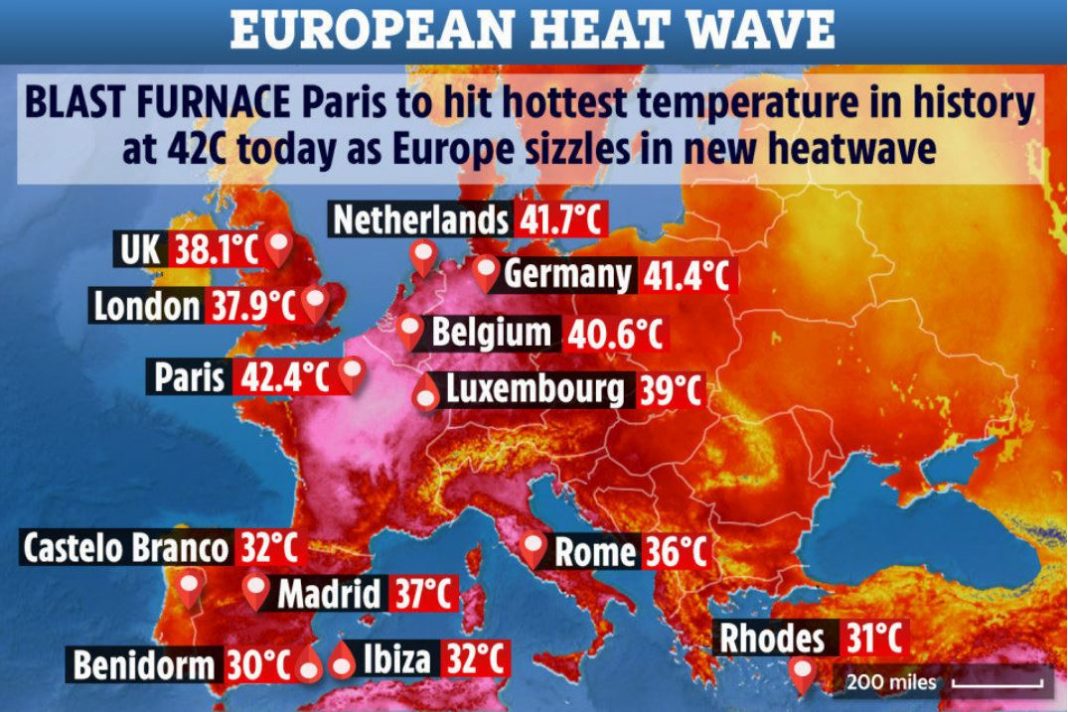
Specific records fell on June 22. Bordeaux reached 41.9 degrees Celsius (107.4 degrees Fahrenheit), surpassing a record from last August. In Poitiers, the temperature hit 41.2 Celsius (106.16 degrees Fahrenheit), the highest since 1947. Preliminary numbers from Meteo-France place Paris at 38.4 degrees Celsius (101.12 degrees Fahrenheit), its highest June temperature.
How is the heat affecting infrastructure and business?
Italy issued red heat wave alerts for 12 cities on Monday. In Turin, the utility company Iren doubled worker shifts and deployed additional generators to manage sporadic power cuts as the electricity grid faced increased strain, according to a company spokesperson.
Educational operations in France were disrupted, with schools either closing or modifying their timetables to accommodate the heat. In Spain, AEMET spokesperson Rubén del Campo stated that temperatures in some northern areas are more than 10 degrees above average.
What may happen next in the UK and Belgium?
The UK Met Office predicted a four-day heat wave could push temperatures above 39 degrees Celsius (102.2 degrees Fahrenheit). This would break the previous June records of 35.6 degrees Celsius (96.08 degrees Fahrenheit) set in 1957 and 1976.
Wildlife may continue to suffer as roof temperatures reach 50 to 60 degrees Celsius. Romaine de Jaegere, founder of the Center for the Rehabilitation of Animals Living in the Wild in Belgium, reported that 150 animals, including swifts and sparrows, were admitted to the shelter in three days after jumping from nests to avoid the heat.
Future weather patterns could see intensified storms and higher rainfall, according to Clair Barnes, as climate change continues to push temperatures upward.
Frequently Asked Questions
What is an Omega block?
According to Clair Barnes of Imperial College, it is a weather pattern shaped like the Greek letter Omega, featuring a bulge of hot air in the middle and cooler air on the sides, which draws Sahara air into Europe.
How high are temperatures expected to go in the UK?
The Met Office stated that temperatures in some places could exceed 39 degrees Celsius (102.2 degrees Fahrenheit) during a four-day heat wave.
Why are birds jumping from their nests?
Romaine de Jaegere reported that roof temperatures can reach 50 to 60 degrees Celsius, leading birds like starlings and swallows to jump rather than die in their nests.
Do you believe current urban infrastructure is prepared for temperatures that are 10 degrees above the historic average?