
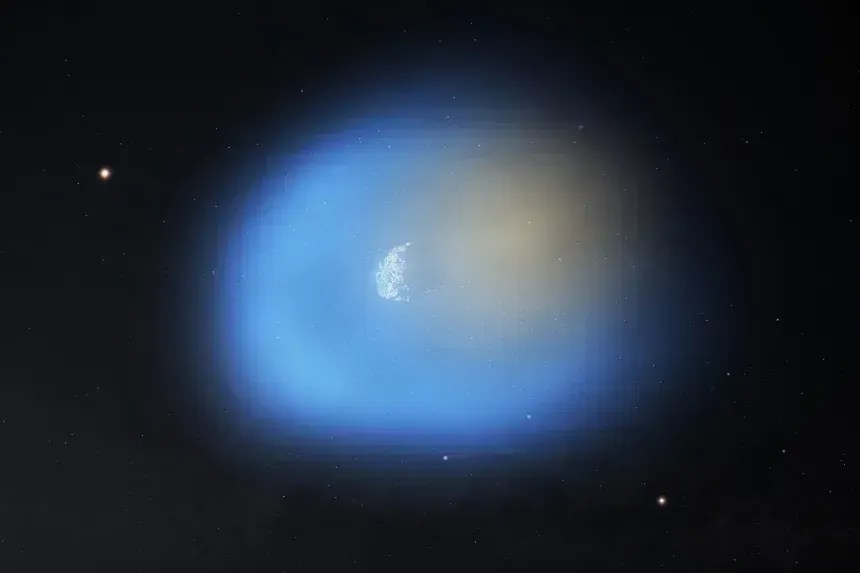
Interstellar Comet 3I/ATLAS: A 12-Billion-Year-Old Cosmic Time Capsule
Comet 3I/ATLAS is an interstellar visitor formed 10 to 12 billion years ago in a primordial planetary system, according to a study published Monday in the journal Nature. Data from the James Webb Space Telescope reveals the object’s chemical composition differs fundamentally from anything in our solar system, featuring water with 30 times more deuterium than local comets.
How does 3I/ATLAS differ from solar system comets?
The chemical makeup of 3I/ATLAS suggests it formed in an environment significantly colder than the one that created Earth. Martin Cordiner, a planetary scientist and astrochemist at NASA’s Goddard Space Flight Center, reports the comet likely originated at temperatures around -243 degrees Celsius (-405 degrees Fahrenheit).
Researchers used the James Webb Space Telescope to measure isotope ratios of hydrogen and carbon. They found that the comet’s water contains roughly 30 times more deuterium—a heavy isotope of hydrogen—than comets found within our own solar system. Cordiner stated that the host system was likely less rich in metals and subjected to more intense cosmic and ultraviolet radiation than our own.
Why is the age of this comet significant?
At 10 to 12 billion years old, 3I/ATLAS is likely the oldest known object to ever traverse our solar system. For comparison, our sun and planets formed approximately 4.5 billion years ago. This means the comet dates back to a time when the universe was only about 13% of its current age, following the Big Bang roughly 13.8 billion years ago.

Cordiner noted that the carbon composition points to a period of intense star formation in the comet’s home region. While researchers believe it formed within the Milky Way, they haven’t ruled out an extragalactic origin. Cordiner mentioned that a fast-moving object could travel from the Magellanic Clouds—our nearest galactic neighbors—in about a billion years.
Could 3I/ATLAS provide clues about alien life?
Despite its frozen origins, 3I/ATLAS is rich in organic molecules containing carbon, hydrogen, nitrogen, oxygen, and sulfur. According to Cordiner, this proves that the volatile elements necessary for life as we know it were abundant even in distant, cold planetary disks billions of years ago.
This finding shifts the understanding of “habitable” conditions. It suggests that the building blocks of life aren’t exclusive to systems like ours but were widespread during the universe’s early stages of star and planet formation.
What is the future trajectory of the comet?
The comet, which measures about 2.6 km (1.6 miles) in diameter, is currently moving toward the orbit of Saturn. NASA and ESA data indicate it will pass the orbit of the dwarf planet Pluto by 2029. It’s expected to exit the outer boundaries of our solar system around 2035.
Cordiner dismissed previous speculations that the object was an artificial alien spacecraft. He stated that evidence from the start showed a comet-like object, and subsequent observations confirmed this natural interpretation.
Comparison: Interstellar Visitors to Date
| Object | Discovery Year | Key Characteristic |
|---|---|---|
| 1I/’Oumuamua | 2017 | Unusual elongated shape |
| 2I/Borisov | 2019 | Clear cometary coma |
| 3I/ATLAS | Current | Extreme age (10-12bn years) |
Frequently Asked Questions
Is 3I/ATLAS dangerous to Earth?
No. Its trajectory is taking it away from the inner solar system toward Saturn and eventually out of our system entirely.

How did it get here?
Cordiner suggests it was likely ejected from its original system due to gravitational interactions with other planets or a massive collision.
What telescope was used to study it?
The James Webb Space Telescope provided the high-resolution spectroscopic data needed to analyze its isotopes.
What do you think about the discovery of organic molecules on a 12-billion-year-old comet? Does this make the existence of alien life more likely? Let us know in the comments or subscribe to our newsletter for more space updates.